Can a Hospital Information System (HIS) Predict Operational Crises
What if a hospital could identify the early signs of an operational crisis before the problem becomes difficult to manage? Rising patient volumes, longer waiting times, increasing bed occupancy, resource pressure, and workflow bottlenecks can all provide valuable signals.
A Hospital Information System (HIS) cannot predict the future with certainty. However, when hospital data is properly collected, integrated, and analyzed, it can help identify patterns and early warning indicators that support proactive decision-making. This allows hospital leaders to move from reacting to problems toward preparing for them.
Can a Hospital Information System (HIS) Predict Operational Crises?
Operational crises rarely appear completely out of nowhere.
In many hospitals, a major operational problem is preceded by a series of smaller changes.
Patient waiting times gradually increase.
Emergency department volumes begin to rise.
Bed occupancy approaches capacity.
Certain resources are consumed faster than usual.
A particular department starts processing more requests than it normally handles.
Individually, these changes may not appear alarming.
But when several indicators move in the same direction, they can reveal a developing operational risk.
This raises an important question:
Can a Hospital Information System (HIS) identify these signals before they become a serious operational crisis?
The answer requires an important distinction.
A Hospital Information System (HIS) does not magically know what will happen in the future.
Instead, when supported by reliable data, integration, analytics, and appropriate monitoring, it can help hospitals identify patterns and early warning signals that may indicate an emerging operational problem.
That changes the role of hospital data from simply recording what happened to helping management prepare for what may happen next.
What Is an Operational Crisis in a Hospital?
An operational crisis does not necessarily mean a catastrophic event.
It can begin with a relatively small problem that gradually affects the hospital's ability to operate efficiently.
Examples may include:
- Severe emergency department overcrowding.
- Increasing patient waiting times.
- Limited bed availability.
- Unexpected resource shortages.
- Excessive pressure on a specific department.
- Delays in operational workflows.
- Growing diagnostic service requests.
- Increased employee workload.
- Bottlenecks between departments.
- Delays in billing or insurance processes.
- Disruptions in critical workflows.
The important point is that many of these situations can generate measurable indicators before they become major problems.
And this is where hospital data becomes valuable.
Can an HIS Really Predict an Operational Crisis?
It is important to distinguish between predicting an event with certainty and identifying signals associated with a potential problem.
A Hospital Information System (HIS) cannot guarantee that a particular crisis will happen at a specific time.
However, historical and real-time data can be analyzed to identify recurring patterns, unusual changes, and operational trends.
For example, if hospital data consistently shows higher emergency department demand during specific periods, combined with rising waiting times and increasing bed occupancy, these indicators may help management prepare for periods of increased operational pressure.
The value is therefore not about "knowing the future."
It is about recognizing early signals that may provide more time to prepare.
How Can a Hospital Information System Identify Early Warning Signals?
The process starts with data.
Hospitals generate large amounts of information through registration, appointments, outpatient services, emergency departments, laboratories, radiology, pharmacies, billing, insurance, beds, resources, and other operational activities.
When this information is properly connected, it can be analyzed to identify patterns.
A simplified model looks like this:
Historical data + current data + performance indicators + analytics = better operational visibility
The quality of this process depends heavily on the quality and consistency of the underlying data.
If important information remains isolated in disconnected systems, the hospital may struggle to create a complete picture.
1. Predicting Increased Emergency Department Pressure
Emergency departments can experience significant changes in demand.
If historical data shows recurring patterns in emergency visits during specific days, hours, seasons, or circumstances, this information can support operational planning.
Management can monitor indicators such as:
- Current patient volume.
- Rate of incoming patients.
- Average waiting time.
- Bed occupancy.
- Service demand.
- Processing times.
- Patient flow.
When several indicators begin changing simultaneously, management may receive an early signal that operational pressure is increasing.
This does not guarantee that a crisis will occur.
But it can provide an opportunity to prepare resources and workflows before pressure becomes more severe.
2. Identifying Potential Bed Capacity Pressure
Hospital bed management requires continuous visibility.
If occupancy rates are consistently increasing while admission patterns indicate that demand may continue rising, the hospital may face capacity pressure.
Analytics can help management monitor:
- Current occupancy.
- Admission rates.
- Discharge rates.
- Average length of stay.
- Department-level occupancy.
- Historical demand patterns.
This information can help managers identify departments approaching capacity and plan accordingly.
The objective is not to predict the exact number of available beds with absolute certainty.
It is to provide better visibility before capacity becomes a critical constraint.
3. Detecting Increasing Patient Waiting Times
Waiting time is often treated as a patient experience metric.
But it can also be an operational warning signal.
If waiting times begin increasing gradually, the underlying cause may be related to several factors.
Patient volume may have increased.
A specific resource may be under pressure.
Appointment scheduling may have become less efficient.
A particular department may have become a bottleneck.
By continuously monitoring waiting-time trends, hospitals can identify changes earlier and investigate their causes before they spread across the wider patient journey.
4. Identifying Operational Bottlenecks
A hospital may have sufficient overall capacity but still experience serious delays because one part of the workflow cannot keep up with demand.
That part becomes an operational bottleneck.
For example, the number of patients may be manageable, but a specific service may be processing requests more slowly than they are being generated.
Analytics can help compare:
Demand versus operational capacity.
When a gap continues over time, management can investigate whether additional resources, workflow changes, scheduling adjustments, or other interventions are needed.
5. Monitoring Resource Utilization
Operational crises are not always caused by patient volume.
Sometimes the warning signal comes from resources.
A sudden increase in the consumption of specific supplies.
Higher demand for a particular medication.
Increased utilization of certain equipment.
Greater pressure on specific facilities or services.
These changes can be monitored through operational data.
When current utilization differs significantly from established patterns, management can investigate the reason before the situation develops into a more serious shortage or service disruption.
6. Identifying Seasonal Patterns
Some operational changes are predictable because they follow recurring seasonal patterns.
Certain services may experience higher demand during specific periods of the year.
Patient volumes may change.
Certain departments may experience increased pressure.
Historical hospital data can help identify these recurring patterns.
Instead of waiting for the same operational challenge to appear again, management can use previous data to support planning for expected changes in demand.
In this context, historical data becomes more than a record of the past.
It becomes a planning resource for the future.
7. Detecting Unusual Changes
Not every operational problem follows a known seasonal pattern.
Sometimes the warning signal is simply a significant deviation from normal activity.
For example, a department may normally process a relatively stable number of requests each day, followed by an unexpected and sustained increase.
Or the completion rate of a particular service may suddenly decline.
A change does not automatically mean that a crisis is developing.
It may be normal variation.
However, unusual deviations can provide a reason for management to investigate.
This is where analytics can help identify changes from established operational patterns.
8. Connecting Multiple Indicators
One of the most valuable aspects of hospital analytics is the ability to look at multiple indicators together.
An increase in waiting time alone may not indicate an operational crisis.
An increase in patient volume alone may be expected.
Higher bed occupancy alone may also be normal.
But what happens when all three increase at the same time?
The situation becomes more meaningful.
Connected data allows management to examine relationships between indicators rather than treating every metric as an isolated number.
This is one of the reasons why data integration is an important part of hospital digital transformation.
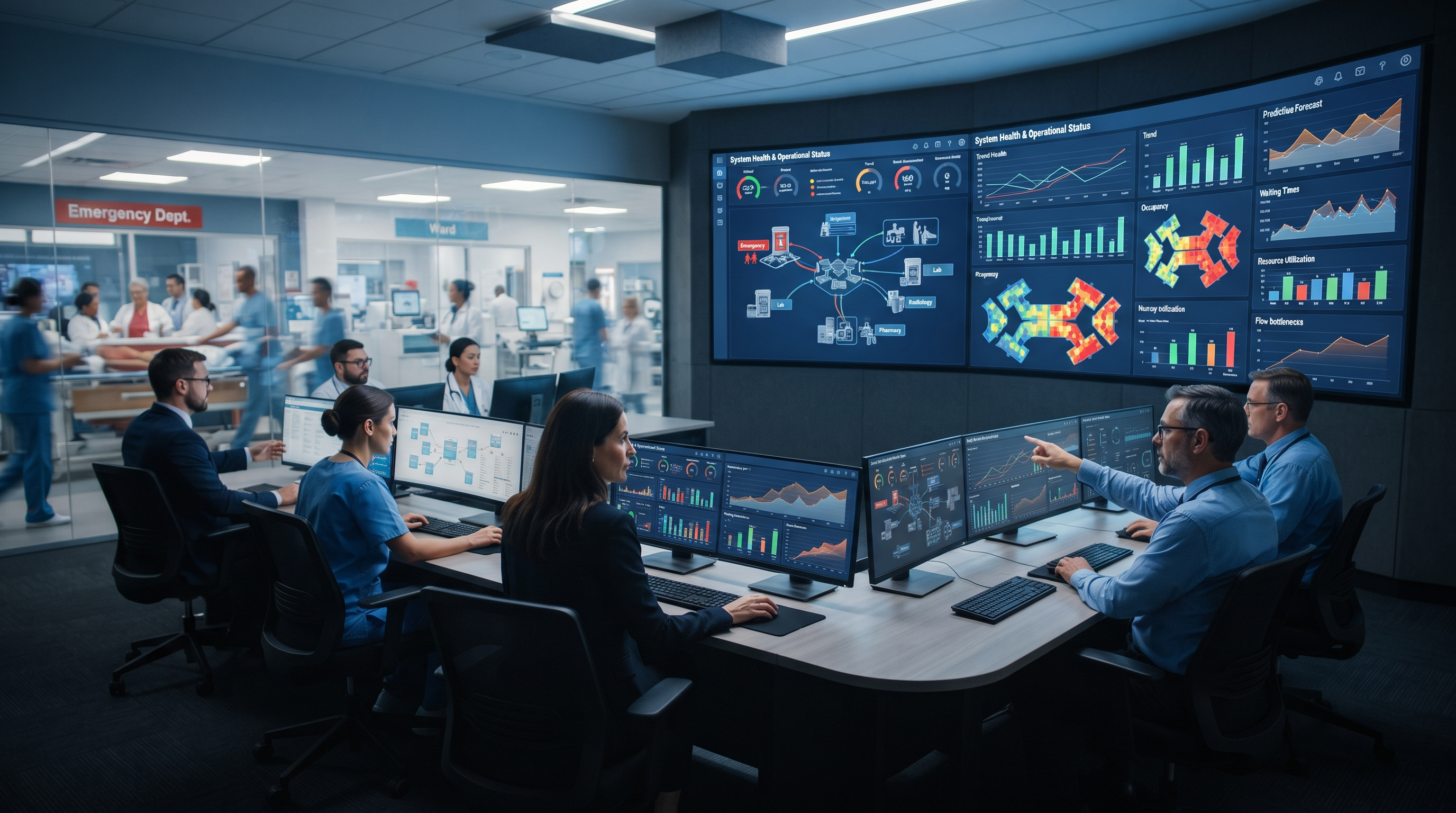
9. Dashboards and Early Warning Systems
Even when data is available, managers need a practical way to understand it.
This is where dashboards and performance monitoring become important.
A hospital management dashboard can monitor indicators such as:
- Waiting times.
- Bed occupancy.
- Patient volume.
- Admission and discharge rates.
- Department performance.
- Resource utilization.
- Service volumes.
- Financial and operational indicators.
When appropriate thresholds, trends, or alerts are established, these tools can direct management attention toward areas that may require investigation.
This is closer to an early warning approach than traditional reporting.
Instead of simply showing what happened, the system helps highlight what is changing.
10. Moving From Reaction to Preparation
One of the most important benefits of operational analytics is the ability to change the management mindset.
Instead of asking:
"The problem has happened. What should we do?"
Management can begin asking:
"Several indicators are changing. What should we do now?"
This is a significant shift.
Traditional reporting is often focused on historical performance.
Predictive and proactive approaches focus more on trends, patterns, and potential risks.
This does not mean every prediction will be correct.
It means that management has additional information that can support earlier planning and intervention.
Does Artificial Intelligence Have to Be Used?
Not necessarily.
Many early warning indicators can be identified using traditional analytics, dashboards, KPIs, thresholds, and business rules.
However, advanced analytics and artificial intelligence can potentially expand the ability to analyze large and complex datasets.
For example, advanced analytical models may identify relationships or patterns that are difficult to detect manually.
But the effectiveness of these technologies depends heavily on the quality and availability of the underlying data.
Artificial intelligence cannot automatically fix poor-quality data or disconnected systems.
Strong predictive capabilities start with a strong digital foundation.
That means reliable data, proper integration, clear definitions, and appropriate governance.
What Role Does a Hospital Information System (HIS) Play?
A Hospital Information System (HIS) can serve as an important component of a hospital's digital infrastructure by connecting relevant operational and clinical information.
Instead of leaving information scattered across completely isolated systems, an integrated Hospital Information System (HIS) can help create a more connected view of hospital operations.
Depending on its capabilities and implementation, it can support:
- Performance monitoring.
- Operational reporting.
- Trend analysis.
- Workflow monitoring.
- Resource visibility.
- Management dashboards.
- Data-driven decision-making.
- Identification of operational bottlenecks.
However, the system itself is not enough.
The quality of the results depends on data quality, system integration, workflow design, user adoption, and the hospital's ability to turn insights into appropriate actions.
What Does a Hospital Need for Effective Operational Prediction?
To benefit from early warning and predictive capabilities, hospitals need several elements working together.
Reliable Data
Poor-quality data can produce unreliable insights.
Integrated Information
Connected data provides a more complete view of hospital operations.
Clear Performance Indicators
Hospitals need to know which metrics actually indicate operational pressure.
Appropriate Analytics
The analytical approach should match the problem, data, and operational objective.
Continuous Monitoring
Operational prediction is not a one-time report. It requires continuous observation of changing conditions.
Management Response
An early warning has little value if nobody acts on it.
Technology can identify a potential problem, but people still have to evaluate the situation and decide what action is appropriate.
Predicting a Crisis Does Not Mean Preventing It
It is important not to overstate what technology can accomplish.
Even advanced analytics cannot guarantee that a hospital will avoid every operational crisis.
Unexpected events can always occur.
Data can also be incomplete.
Models can produce incorrect signals.
Operational conditions can change rapidly.
The objective is therefore not perfect prediction.
The objective is to reduce the element of surprise.
If management can identify a meaningful change early enough, it may have more time to investigate, prepare, allocate resources, or adjust workflows.
That can be operationally valuable even when the prediction itself is not perfect.
From Monitoring the Past to Preparing for the Future
Historically, hospital information systems have often been used primarily to record what has already happened.
How many patients visited?
How many procedures were performed?
How much revenue was generated?
How many admissions occurred?
These questions remain important.
But modern hospital analytics can go further.
Management can begin asking:
What is happening now?
Why is it happening?
Is this different from the normal pattern?
What could happen if the trend continues?
Where should we investigate or intervene?
This represents a major evolution in the role of healthcare data.
Data moves from being a historical record to becoming a tool that supports planning and operational readiness.
The Future of Hospital Management Is More Proactive
As hospitals become increasingly digital, the value of data will extend beyond reporting.
The next stage is not simply knowing what happened yesterday.
It is understanding what is happening today and identifying signals that may require attention tomorrow.
A connected Hospital Information System (HIS), combined with reliable data, analytics, dashboards, and appropriate operational processes, can provide hospital leaders with greater visibility into emerging trends.
This does not eliminate uncertainty.
But it can help management make decisions with more information and less reliance on assumptions.
Conclusion
Can a Hospital Information System (HIS) predict operational crises?
Not in the sense of knowing the future with certainty.
But when hospital data is properly collected, integrated, and analyzed, a Hospital Information System (HIS) can help identify patterns and early warning indicators associated with potential operational problems.
Rising waiting times, increasing emergency department pressure, growing bed occupancy, unusual resource utilization, and workflow bottlenecks can all provide valuable signals when monitored in context.
The real value is not in guaranteeing that an operational crisis will happen.
It is in giving hospital management an earlier opportunity to recognize changing conditions and prepare for them.
Ultimately, data cannot tell a hospital exactly what the future will look like.
But it can help the hospital become better prepared for what may come next.