Can Healthcare Data Predict Emergency Department Collapse Before It Happens
Emergency departments operate under constant pressure, where unexpected surges in patient volume can quickly overwhelm resources and compromise care quality. Today, hospitals are increasingly using predictive analytics and Hospital Information Systems (HIS) to identify early warning signs of operational stress before a crisis occurs. In this article, we explore how healthcare data can help predict emergency department overload, improve resource allocation, and strengthen hospital readiness.
The emergency department is one of the most critical and dynamic areas within any hospital. It serves as the primary entry point for urgent medical cases, accidents, trauma patients, and life-threatening conditions. Because of its unpredictable nature, emergency care requires exceptional coordination, rapid decision-making, and efficient resource management.
However, many hospitals experience periods when their emergency departments become overwhelmed by patient demand. Long waiting times, overcrowded treatment areas, staff burnout, and delayed care can significantly impact patient outcomes and operational performance.
Historically, healthcare organizations responded to these challenges only after they became visible. Today, advancements in healthcare analytics and digital transformation have introduced a new approach: predicting operational risks before they occur.
With the support of a Hospital Information System (HIS), healthcare leaders can analyze real-time and historical data to detect patterns that indicate increasing pressure on emergency services. This proactive strategy enables hospitals to prevent operational collapse rather than simply reacting to it.
So, can healthcare data truly predict emergency department collapse before it happens?
Increasingly, the answer is yes.
What Does Emergency Department Collapse Mean?
Emergency department collapse does not necessarily mean a complete shutdown of services. Instead, it refers to a situation where the department becomes unable to provide care efficiently due to overwhelming demand or operational bottlenecks.
Common signs include:
- Excessively long waiting times
- Delays in treatment initiation
- Overcrowded waiting areas
- Shortage of available beds
- Increased patient dissatisfaction
- Staff fatigue and burnout
- Reduced quality of care
- Higher risk of medical errors
These conditions can severely affect both patient safety and hospital performance.
Why Do Emergency Departments Become Overwhelmed?
Several factors contribute to sudden increases in emergency department demand.
Seasonal Disease Outbreaks
Influenza, respiratory illnesses, and infectious disease outbreaks often create predictable spikes in patient volume.
Public Health Emergencies
Pandemics and community-wide health crises can dramatically increase emergency visits within a short period.
Mass Casualty Events
Traffic accidents, industrial incidents, and natural disasters can overwhelm emergency services unexpectedly.
Inefficient Resource Planning
Poor staffing allocation, limited bed availability, and workflow inefficiencies often worsen existing pressures.
Lack of Predictive Visibility
Many hospitals continue to rely on reactive management rather than forecasting future demand.
The Growing Importance of Healthcare Data
Modern hospitals generate enormous amounts of operational data every day.
Examples include:
- Patient arrival patterns
- Emergency department visits
- Waiting times
- Bed occupancy rates
- Staffing levels
- Patient discharge rates
- Treatment durations
- Resource utilization metrics
When analyzed correctly, this information becomes a powerful tool for predicting future operational challenges.
Understanding Predictive Analytics in Healthcare
Predictive analytics involves using historical and real-time data to forecast future events.
In emergency departments, predictive analytics can help hospitals estimate:
- Future patient volumes
- Peak demand periods
- Bed shortages
- Staffing requirements
- Potential overcrowding events
- Resource constraints
Rather than waiting for problems to emerge, hospitals can take preventive action.
Early Warning Indicators of Emergency Department Overload
Healthcare data can reveal warning signs long before operational collapse occurs.
Rising Waiting Times
Consistent increases in waiting times often indicate growing operational pressure.
High Bed Occupancy Rates
When bed occupancy remains near maximum capacity for extended periods, emergency departments become vulnerable to congestion.
Increased Patient-to-Provider Ratios
A growing number of patients per physician or nurse can reduce efficiency and care quality.
Delayed Patient Transfers
When admitted patients remain in the emergency department because inpatient beds are unavailable, crowding intensifies.
Extended Length of Stay
Longer patient stays reduce the department's ability to accommodate new arrivals.
Monitoring these indicators helps hospitals recognize emerging risks early.
How Hospital Information Systems (HIS) Support Predictive Analytics
A Hospital Information System (HIS) serves as the foundation for effective healthcare analytics.
Centralized Data Collection
The system gathers information from multiple departments, including:
- Emergency services
- Inpatient units
- Laboratories
- Radiology departments
- Pharmacy systems
- Administrative departments
Real-Time Data Monitoring
Hospital leaders gain immediate visibility into operational performance.
Automated Reporting
The system continuously generates performance reports that support informed decision-making.
Historical Data Analysis
Long-term trends can be identified and used to improve forecasting accuracy.
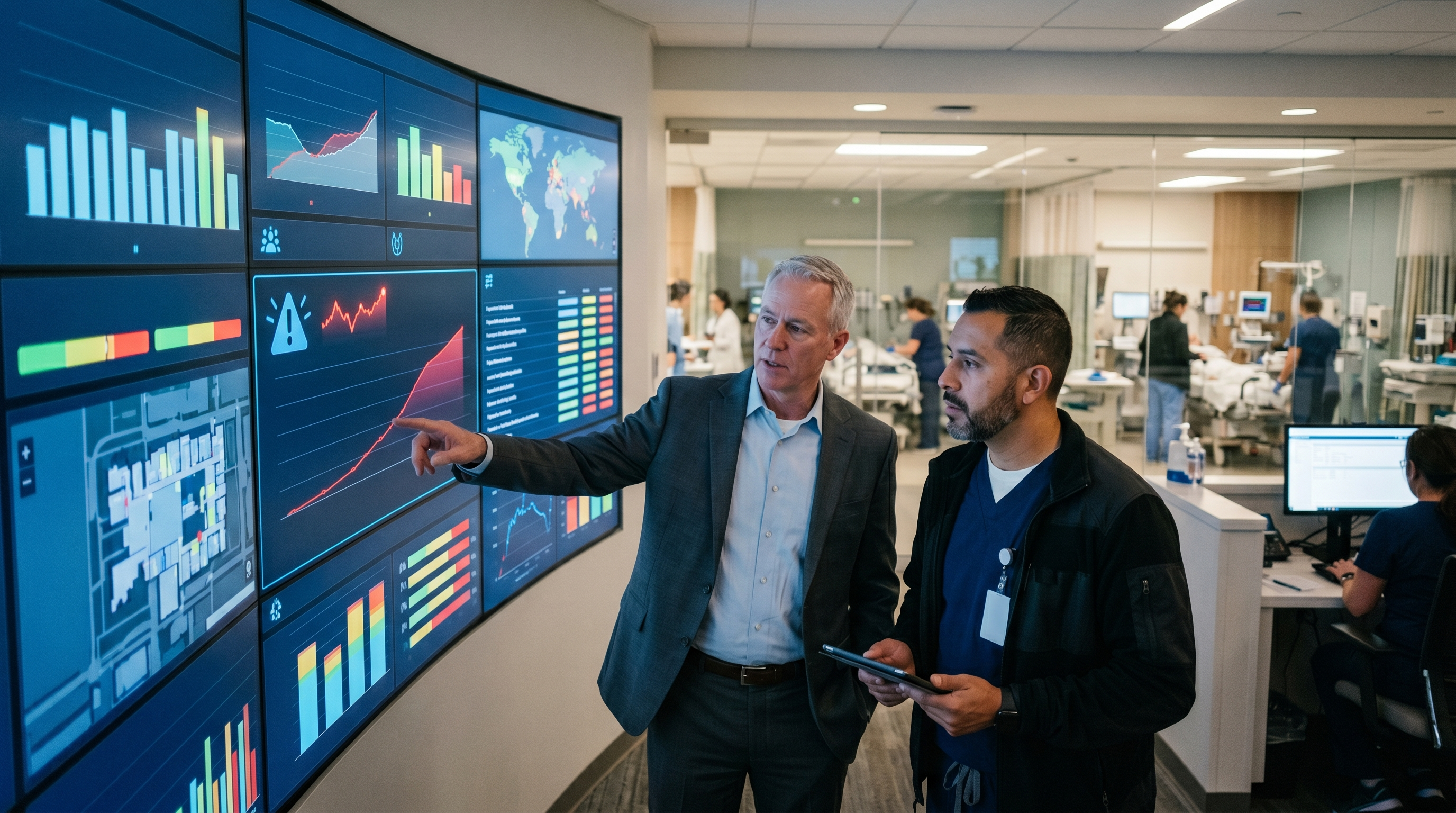
The Role of Smart Dashboards
Modern healthcare dashboards transform complex data into actionable insights.
These dashboards provide real-time visibility into:
- Current patient volumes
- Waiting times
- Bed availability
- Staff utilization
- Department performance
- Emergency department occupancy
This enables hospital managers to respond quickly before operational issues escalate.
Artificial Intelligence and Emergency Department Forecasting
Artificial intelligence is becoming increasingly important in hospital operations.
AI-powered healthcare analytics can:
- Predict patient arrival patterns
- Identify high-risk periods
- Forecast staffing needs
- Detect operational bottlenecks
- Optimize resource allocation
By processing large volumes of data, AI helps hospitals make more accurate predictions than traditional methods.
Benefits of Predicting Emergency Department Overload
Hospitals that use predictive analytics gain significant advantages.
Better Resource Allocation
Staff, equipment, and beds can be distributed based on anticipated demand.
Reduced Waiting Times
Proactive planning helps prevent severe congestion.
Improved Patient Experience
Patients receive faster and more efficient care.
Enhanced Operational Efficiency
Resources are utilized more effectively across departments.
Higher Quality of Care
Reduced operational stress allows clinicians to focus on patient outcomes.
Lower Financial Losses
Preventing overcrowding reduces inefficiencies and operational costs.
Challenges of Implementing Predictive Analytics
Although predictive analytics offers substantial benefits, hospitals may face several challenges.
Data Quality Issues
Inaccurate or incomplete information reduces forecasting reliability.
Disconnected Systems
Lack of integration limits data visibility.
Resistance to Change
Some organizations struggle to adopt data-driven decision-making.
Limited Analytical Expertise
Hospitals may require specialized personnel to manage advanced analytics programs.
Fortunately, modern healthcare technologies continue to make predictive analytics more accessible.
The Shift from Reactive to Proactive Healthcare Management
Healthcare organizations are increasingly moving away from crisis-response models toward proactive management strategies.
Instead of asking:
"How do we respond to overcrowding?"
Hospitals are now asking:
"How can we predict and prevent overcrowding before it occurs?"
This shift represents one of the most important developments in modern healthcare management.
By leveraging healthcare data, predictive analytics, artificial intelligence, and Hospital Information Systems (HIS), hospitals can anticipate challenges and improve operational resilience.
Conclusion
Emergency department overload is one of the most significant operational risks facing healthcare organizations today. However, advances in healthcare analytics have made it possible to identify warning signs long before a crisis develops.
Through a Hospital Information System (HIS), hospitals can collect, analyze, and monitor critical operational data in real time. Combined with predictive analytics and artificial intelligence, these insights enable healthcare leaders to forecast demand, optimize resources, and prevent operational breakdowns.
Ultimately, the most successful hospitals are no longer those that simply respond to emergencies they are the ones that can predict them before they happen.