How Disconnected Hospital Systems Reduce Operational Efficiency
A hospital can invest in multiple digital systems and still struggle with slow processes, duplicated data, delayed reports, and inefficient workflows. The problem is not always a lack of technology it can be the fact that hospital systems operate independently without effectively communicating with each other.
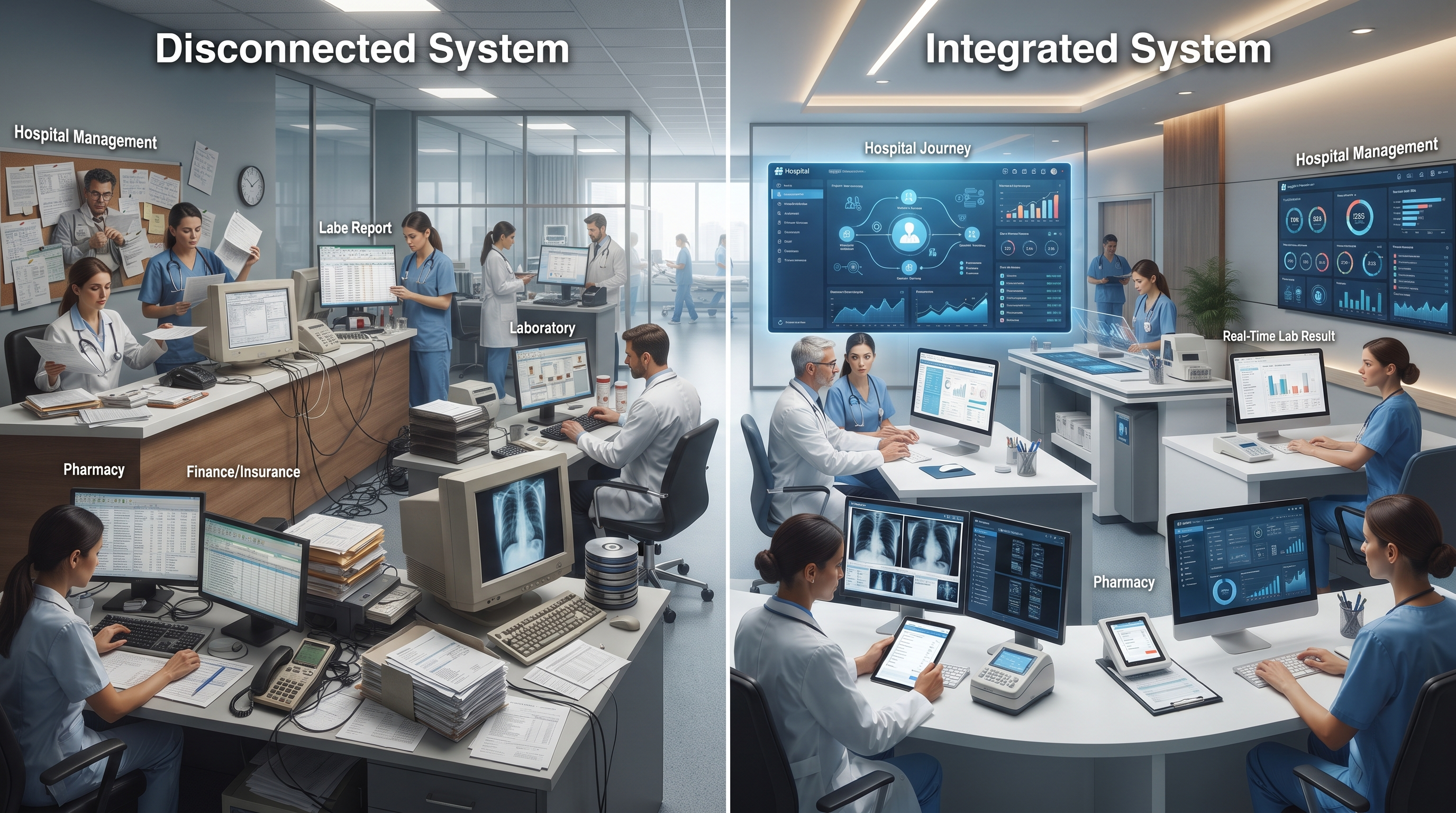
When registration, laboratory, radiology, pharmacy, billing, insurance, and management systems remain disconnected, valuable information becomes fragmented and employees spend more time moving and reconciling data. This is why hospital system integration and a Hospital Information System (HIS) have become increasingly important for improving operational efficiency and supporting data-driven decision-making.
How Disconnected Hospital Systems Reduce Operational Efficiency
Hospitals today rely on technology across almost every part of their operations.
Patient registration systems, laboratory systems, radiology platforms, pharmacy software, billing systems, insurance solutions, inventory platforms, human resources systems, and management dashboards can all play an important role in daily operations.
On the surface, having all these digital systems seems like a sign of digital maturity.
But there is a critical question that hospitals need to ask:
Can these systems communicate with each other effectively?
Because having more digital systems does not automatically mean having a more efficient hospital.
When systems operate independently, hospitals may face duplicated data entry, manual processes, delayed access to information, inconsistent reports, and difficulty making timely decisions.
The result is a paradox:
The hospital becomes more digital, but not necessarily more efficient.
This is where hospital system integration becomes essential.
What Are Disconnected Hospital Systems?
Disconnected hospital systems are software platforms or applications that operate independently and have limited ability to exchange the information required by other systems or departments.
For example, patient information may be entered into a registration system and then manually entered again into another application.
Laboratory results may exist in one system while clinicians or administrators need to access the information through another workflow.
Management may also rely on Excel spreadsheets and manually prepared reports to combine information from multiple departments.
The problem is not necessarily having multiple systems.
A hospital may legitimately need specialized solutions for different functions.
The problem occurs when these systems become isolated data environments.
Instead of information flowing through the hospital, employees have to move the information themselves.
How Do Disconnected Systems Affect Hospital Efficiency?
The impact of disconnected systems goes far beyond the IT department.
It can affect employees, managers, patients, workflows, data quality, resource utilization, and financial performance.
Here are some of the most important consequences.
1. Repeated Data Entry
One of the most obvious consequences of disconnected hospital systems is the need to enter the same information multiple times.
A patient's information may be entered during registration and then manually transferred into another system used by another department.
The same process may happen again for billing, insurance, laboratory, or other operational workflows.
Every repeated entry consumes employee time.
But time is not the only issue.
Every manual transfer also creates another opportunity for a data-entry error.
This creates two problems at the same time:
More time spent on administrative work and a higher risk of inconsistent information.
A properly integrated environment can reduce unnecessary duplication by allowing relevant information to move between connected workflows without requiring employees to repeatedly enter the same data.
2. Slower Access to Information
In a hospital environment, timely access to information can have a significant operational impact.
When information is distributed across disconnected systems, employees may need to search multiple platforms to find what they need.
They may have to:
- Contact another department.
- Send an email.
- Make a phone call.
- Request a report.
- Open a separate spreadsheet.
- Wait for another employee to provide the information.
Each individual step may appear insignificant.
But when these steps are repeated hundreds of times, they become a meaningful operational cost.
Integrated hospital systems can help make authorized information available within the appropriate workflow, reducing unnecessary information searching and manual communication.
3. Difficulty Creating a Unified View of Hospital Operations
Hospital management needs more than isolated departmental information.
Executives and managers need to understand what is happening across the organization.
For example:
- Which departments are experiencing the highest workload?
- Where are operational bottlenecks occurring?
- How are resources being utilized?
- Where are delays increasing?
- How are revenues performing?
- Which services require management attention?
- What operational trends are changing?
The information needed to answer these questions may already exist.
The problem is that it may be distributed across multiple systems.
This leads to an important distinction:
Having data is not the same as having usable information.
4. Inconsistent Data and Reports
Disconnected systems can create another serious challenge: different departments may start working with different versions of the same information.
One department may use one figure.
Another department may use a different figure.
An Excel spreadsheet may contain a newer update than the official report.
Management then has to answer a question before making any decision:
Which number is actually correct?
This creates unnecessary reconciliation work and can reduce confidence in management reports.
A connected digital environment can help establish more consistent information flows and provide a stronger foundation for reporting and analytics.
5. Increased Dependence on Manual Processes
The more disconnected the systems are, the more manual work is often required to connect them.
Employees may spend time:
- Copying information between systems.
- Preparing reports manually.
- Comparing data from different sources.
- Updating spreadsheets.
- Sending information by email.
- Checking data for inconsistencies.
- Communicating with other departments.
This creates an important contradiction.
A hospital may technically be digital while still relying heavily on manual processes.
That means the hospital has achieved digitization without fully achieving operational transformation.
6. Increased Employee Workload
Technology should ideally make employees' work easier.
But disconnected systems can have the opposite effect.
Imagine an employee who needs to enter the same information into three different applications.
The hospital has invested in digital technology, but the employee still performs essentially the same task three times.
The same applies to reporting.
Instead of focusing on analysis or patient-related responsibilities, employees may spend significant amounts of time collecting, transferring, and reconciling information.
This is why the success of digital systems should not be measured only by whether they have been installed.
It should also be measured by whether they simplify the work they were designed to support.
7. Slower Data-Driven Decision-Making
Effective data-driven decision-making requires information that is accessible, reliable, and connected.
When hospital data is distributed across isolated systems, management may need considerable time to collect and reconcile information before analysis can even begin.
This delays decision-making.
An integrated environment can help hospitals move toward a more efficient process:
Connected data → clearer visibility → faster analysis → informed decisions
Instead of spending most of the time finding the data, managers can spend more time understanding what the data means and deciding what action is appropriate.
8. Impact on the Patient Experience
Patients may never see the technology infrastructure behind a hospital.
But they experience its results.
When systems are disconnected, patients may encounter unnecessary repetition, such as providing the same information multiple times or waiting while information is transferred between departments.
Delays can appear across different stages of the patient journey, including registration, appointments, approvals, billing, and other administrative processes.
Integrated systems can help reduce unnecessary steps and improve the flow of information between departments.
Therefore, hospital system integration is not simply an IT initiative.
It can also contribute to improving the overall patient experience.
9. Limited Real-Time Performance Visibility
Hospital management does not always need to know what happened at the end of the month.
In many situations, managers need to understand what is happening now.
Disconnected systems can make this difficult.
Data may need to be collected from several sources before management reports can be prepared.
By the time the report becomes available, the situation may already have changed.
Integrated systems and appropriate dashboards can provide more connected visibility into operational performance.
This allows management to monitor trends and identify issues earlier rather than relying exclusively on historical reports.
10. Hidden Operational Costs
The cost of disconnected systems is not limited to software licenses or implementation expenses.
There are also hidden operational costs associated with:
- Employee time.
- Repeated data entry.
- Manual reporting.
- Data reconciliation.
- Correcting errors.
- Delayed processes.
- Inefficient resource utilization.
- Manual communication between departments.
These costs may not appear as a single line item on the hospital's financial statements.
However, they can accumulate over time.
This is why hospitals should evaluate technology not only according to its purchase price, but also according to its impact on the total cost of operating the process.
Does Hospital Integration Mean Using One System for Everything?
Not necessarily.
Integration does not mean that every hospital function must be managed by a single software platform.
Hospitals may require specialized systems for specific clinical, administrative, financial, or operational functions.
The important issue is whether the necessary systems can communicate and exchange information effectively, securely, and in a structured way.
This is where a Hospital Information System (HIS) can become an important component of a hospital's digital infrastructure.
The goal is not to eliminate every separate system.
The goal is to eliminate unnecessary isolation between systems when that isolation negatively affects workflows and decision-making.
How Can System Integration Improve Hospital Efficiency?
When integration is designed and implemented properly, hospitals can improve several areas simultaneously.
Reducing Duplicate Data Entry
Information can be captured at the appropriate point and reused across connected workflows instead of being repeatedly entered.
Improving Access to Information
Authorized employees can access relevant information within the context of their workflow.
Improving Data Consistency
Reducing manual data transfer can help reduce certain forms of duplication and data-entry inconsistency.
Improving Reporting
Connected data sources can provide a stronger foundation for more consistent reporting and analytics.
Supporting Management
Integrated information can give managers greater visibility into operational performance and help them identify areas requiring attention.
Streamlining Workflows
Connecting processes across departments can reduce unnecessary steps and make information flow more efficiently through the organization.
How Can a Hospital Identify a Disconnected-System Problem?
Several signs may indicate that a hospital's digital environment is too fragmented.
These may include:
- Employees entering the same information multiple times.
- Heavy dependence on Excel spreadsheets.
- Frequent manual report preparation.
- Different figures appearing in different reports.
- Difficulty obtaining information from another department.
- Frequent phone calls or messages to transfer information.
- Delays in management reporting.
- Multiple systems that cannot effectively exchange data.
- No unified view of operational performance.
- Employees feeling that technology adds work instead of reducing it.
Each sign may appear relatively small on its own.
But when several of these problems exist simultaneously, they can indicate a deeper issue with the hospital's digital architecture.
From Digitization to Integration
Digital transformation does not end when paper documents are replaced with electronic records or when a hospital purchases new software.
One of the most important stages is connecting information and workflows.
A hospital does not operate as a collection of isolated departments.
The patient journey is interconnected.
Financial operations are connected to services.
Resources are connected to demand.
And management decisions depend on information generated across multiple functions.
The hospital's digital infrastructure should reflect this interconnected reality.
The Role of a Hospital Information System (HIS)
A Hospital Information System (HIS) can support this connected environment by bringing relevant hospital processes and information together within a structured digital framework.
Depending on the system's capabilities and implementation, this can support areas such as patient administration, clinical workflows, billing, reporting, analytics, and operational management.
The real value, however, does not come simply from having an HIS.
It comes from how effectively the system connects with the hospital's broader workflows and technology environment.
A hospital can purchase sophisticated software and still experience inefficiencies if the implementation does not address the underlying process and integration challenges.
Therefore, technology, workflow design, integration, user adoption, and data governance should be considered together.
The Future of Hospital Digital Transformation Is Connected
The next stage of hospital digital transformation is not necessarily about adding more software.
It is about making existing and necessary technologies work together more effectively.
Hospitals need information to move with the workflow.
Employees need access to the information relevant to their responsibilities.
Managers need connected visibility across departments.
And patients should not have to experience unnecessary complexity because systems behind the scenes cannot communicate.
This is why integration has become an important part of modern hospital technology strategies.
Conclusion
Disconnected hospital systems can create a significant gap between having digital technology and achieving digital efficiency.
A hospital may have multiple advanced systems and still experience duplicated data entry, manual processes, inconsistent reports, delayed information, employee workload, and fragmented decision-making.
The problem is not necessarily the number of systems.
The problem is when those systems operate like isolated islands.
Hospital system integration can help connect information, workflows, departments, and management visibility.
When data flows effectively between the right systems, technology can move beyond simply digitizing existing processes and begin supporting genuine operational improvement.
Ultimately, the strength of a hospital's digital infrastructure should not be measured by how many systems it owns.
It should be measured by how effectively its information, processes, people, and decisions work together.