How Successful Hospitals Detect Problems Before They Become Crises: 7 Early Warning Indicators
Discover how successful hospitals detect operational, financial, and medical risks before they become crises. Learn how data analytics, performance dashboards, and a Hospital Information System (HIS) support proactive hospital management.
In healthcare institutions, crises do not always begin with sudden or dramatic events. Many develop gradually as small operational, financial, or clinical warning signs accumulate without receiving enough attention.
Increasing patient waiting times, rising appointment cancellations, shortages of medical supplies, delayed laboratory results, and declining revenues are all examples of indicators that may reveal deeper problems within a hospital.
The difference between a hospital that reacts to problems after they occur and one that identifies risks early is not necessarily the size of its resources or workforce. It largely depends on its ability to monitor performance, analyze information, and detect unusual changes.
This is where proactive hospital management becomes essential. By using reliable data, performance indicators, and healthcare information systems, hospitals can identify potential risks before they affect daily operations or healthcare quality.
What Is Proactive Hospital Management?
Proactive hospital management is an approach that focuses on monitoring operations, analyzing data, and identifying early warning signs before potential problems develop into serious operational challenges or crises.
Unlike traditional reactive management, which often responds after a problem has already appeared, proactive management focuses on answering important questions:
- Is a department approaching its operational capacity?
- Are patient waiting times increasing unexpectedly?
- Are medical inventory levels declining?
- Is the performance of a particular department deteriorating?
- Are operational costs increasing without a clear reason?
- Are medical or administrative procedures experiencing repeated delays?
Proactive management does not mean that hospitals can predict every crisis or prevent every problem. Instead, it helps management identify potential risks, evaluate their likelihood and impact, and prepare appropriate responses before situations become more difficult to control.
7 Ways Successful Hospitals Detect Problems Before They Become Crises
1. Continuously Monitoring Key Performance Indicators (KPIs)
Successful hospitals rely on key performance indicators to monitor clinical, administrative, financial, and operational performance.
Instead of waiting for patient complaints or financial losses, management tracks indicators that reveal changes in departmental performance.
Important hospital KPIs include:
- Average patient waiting time.
- Hospital bed occupancy rate.
- Appointment cancellation rate.
- Average length of stay.
- Laboratory turnaround time.
- Medical resource utilization.
- Revenue and collection rates.
- Administrative error and rework rates.
For example, if the average waiting time in outpatient clinics gradually increases over several weeks, this may indicate rising patient demand, inefficient appointment scheduling, or an imbalance in physician availability.
Monitoring this indicator allows management to investigate the underlying cause before delays become a recurring problem that affects patient experience and hospital reputation.
The key principle: Successful hospital management does not wait for negative outcomes. It monitors the indicators that may lead to them.
2. Analyzing Unusual Changes in Hospital Data
Monitoring KPI values at a single point in time is not enough. Hospitals also need to understand how performance changes over time.
For example, a hospital's bed occupancy rate may appear normal on a particular day but show a continuous increase compared with previous weeks.
Similarly, operational expenses may seem acceptable, yet they could be rising consistently without a corresponding increase in the volume of services delivered.
This is why analyzing historical data and comparing current performance with previous patterns is important.
Hospitals can analyze:
- Changes in patient volumes across different periods.
- Demand patterns for clinics and medical specialties.
- Medical supply consumption trends.
- Revenue and expense patterns.
- Medical equipment and resource utilization.
- Differences between actual and target performance.
This analysis helps management identify unusual deviations and determine which departments require further investigation.
By continuously comparing performance, hospitals can distinguish between normal seasonal fluctuations and emerging problems that require intervention.
3. Detecting Operational Bottlenecks Before They Escalate
Some hospital problems originate from a bottleneck in a specific stage of the workflow rather than poor performance across the entire institution.
For example, patient registration may be completed quickly, but patients may experience long delays before entering the examination room.
Similarly, laboratory tests may be completed on time, while delays in reviewing the results interrupt the next steps in patient care.
Hospitals therefore need to monitor the entire patient journey, from registration to the completion of medical services.
Important operational stages to monitor include:
- Patient registration and reception.
- Waiting time before consultations.
- Laboratory tests and diagnostic procedures.
- Radiology report processing.
- Inpatient admission procedures.
- Patient discharge and billing.
Once the stage causing the delay is identified, management can adjust workflows or redistribute resources to address the actual problem.
This helps hospitals reduce operational bottlenecks before they lead to overcrowding, repeated complaints, or declining service efficiency.
4. Monitoring Hospital Resources and Capacity
Resource shortages and inefficient resource allocation can create operational crises that affect a hospital's ability to deliver healthcare services.
This does not only involve hospital beds. It also includes physicians, nursing staff, medical supplies, medications, and medical equipment.
For example, demand for a particular department may increase during a specific period while resources remain allocated according to historical usage patterns.
If management fails to identify this change early, the department may experience resource shortages or excessive pressure on its staff.
Hospitals should therefore monitor indicators such as:
- Bed occupancy rates.
- Medication and medical supply availability.
- Medical equipment utilization.
- Physician and nursing staff distribution.
- Demand for different medical services.
- Resource consumption compared with previous periods.
These indicators help management improve planning and allocate resources according to actual needs rather than outdated estimates.
5. Analyzing Patient Complaints and Feedback as Early Warning Signals
Patient complaints are more than service-related comments. They can provide valuable information about operational and administrative problems.
When complaints about long waiting times, delayed laboratory results, or appointment difficulties become more frequent, they may indicate weaknesses in specific hospital processes.
However, handling every complaint individually is not enough.
Hospitals need to categorize complaints, analyze their causes, monitor their frequency, and connect them to the relevant departments and services.
For example:
- Increasing waiting-time complaints may indicate scheduling problems.
- Repeated complaints about delayed test results may reveal laboratory workflow bottlenecks.
- Recurring billing complaints may indicate weaknesses in financial procedures.
- Communication-related complaints may reveal coordination problems between departments.
When patient feedback becomes structured and measurable data, management can identify root causes and address problems before they spread.
6. Monitoring Financial Indicators and Detecting Revenue Leakage
Financial problems in hospitals do not always begin with a sudden decline in revenue. They may develop through small, repeated losses that remain unnoticed.
These issues may include medical services that were delivered but not properly recorded, delayed collections, excessive resource consumption, or discrepancies between services provided and invoices issued.
Hospital management should therefore monitor financial indicators continuously, including:
- Total revenue by department and service.
- Collection rates and outstanding balances.
- Insurance claim rejection rates.
- Operational expenses.
- Cost of delivering medical services.
- Differences between recorded services and issued invoices.
- Changes in profit margins.
For example, if patient volumes and delivered services increase without a corresponding increase in revenue, this may indicate a problem in service recording, billing, or collection processes.
Detecting these indicators early helps hospitals reduce financial losses and strengthen financial control before the situation affects institutional stability.
7. Using Predictive Analytics and Early Warning Systems
Advanced healthcare institutions are increasingly exploring data analytics and artificial intelligence to identify patterns and changes that may indicate future risks.
Predictive analytics uses historical and current data to estimate the likelihood of certain events or problems, depending on data quality and the accuracy of the analytical models.
Potential applications include:
- Forecasting increases in emergency department demand.
- Estimating future hospital bed requirements.
- Identifying potential shortages of medical supplies.
- Detecting departments that may experience operational pressure.
- Analyzing patterns associated with procedural delays.
- Identifying unusual changes in expenses and revenue.
Dashboards and alert systems can also notify responsible managers when an indicator exceeds a predefined threshold.
For example, a hospital may configure an alert when bed occupancy reaches a level that requires reviewing available capacity, or when the stock of a critical medical supply falls below its defined safety level.
However, predictive analytics cannot guarantee that a problem will occur or determine its exact timing. It provides estimates that help management prepare and make more informed decisions.
Reactive vs. Proactive Hospital Management: What Is the Difference?
The main difference between reactive and proactive management is when problems are identified and how they are addressed.
|
Reactive Hospital Management |
Proactive Hospital Management |
|
Responds after problems appear |
Identifies early warning signs |
|
Relies heavily on complaints and incidents |
Uses performance indicators and data |
|
Focuses on treating outcomes |
Investigates root causes |
|
Makes decisions under time pressure |
Makes decisions based on continuous monitoring |
|
Risks allowing problems to escalate |
Creates opportunities for early intervention |
For example, reactive management may begin addressing emergency department overcrowding only after the department reaches a critical pressure level.
Proactive management, on the other hand, analyzes patient arrival rates, emergency demand, and available capacity to identify changes that may require resource redistribution or activation of an emergency plan.
This does not eliminate the need for crisis response plans. Instead, effective hospital management combines early preparation with the ability to respond quickly when problems occur.
How Does a Hospital Information System (HIS) Help Detect Problems Early?
A Hospital Information System (HIS) plays an important role in supporting proactive hospital management by organizing data, connecting workflows, and providing information needed to monitor performance.
Instead of depending on separate reports prepared manually, hospitals can use an integrated system to gain a more comprehensive view of clinical, administrative, and financial operations, depending on the system's available modules and capabilities.
Key benefits include:
1. Providing a Unified View of Departmental Performance
An HIS helps organize information related to patients, clinics, departments, and services, making it easier to monitor performance and identify changes.
2. Monitoring KPIs Through Dashboards
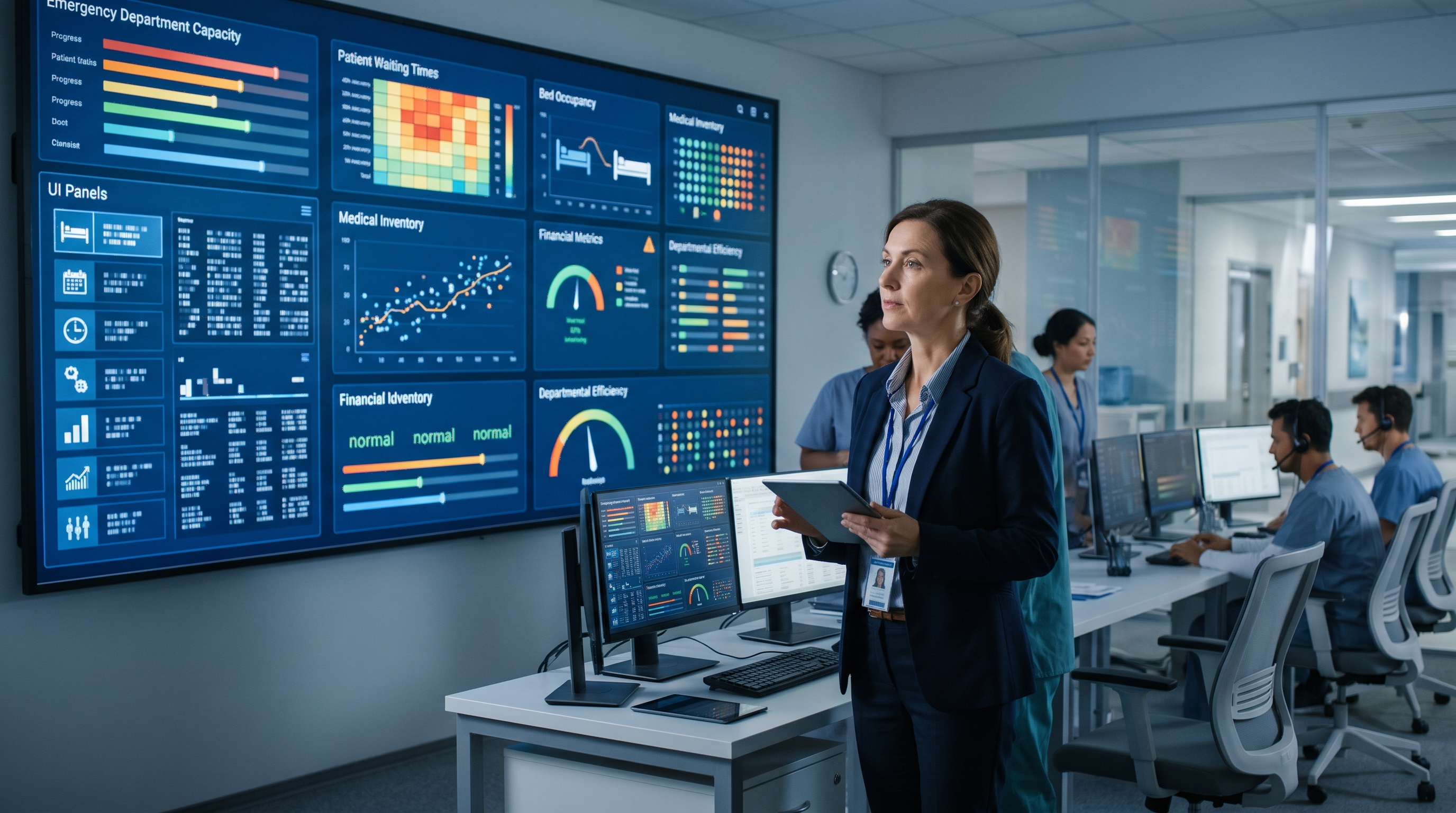
Dashboards can help management track indicators such as patient volumes, occupancy rates, revenue, and waiting times, depending on system configuration and available features.
3. Improving Reporting Speed
Organized information helps reduce the time required to collect data from multiple sources and prepare periodic reports.
4. Identifying Operational and Financial Deviations
By comparing actual performance with targets or historical results, management can identify indicators that require investigation and intervention.
5. Supporting Coordination Between Departments
Integrating different system modules helps improve information consistency and reduces dependence on manual data transfers between employees.
6. Supporting Alerts and Follow-Up
Where supported, alert rules can be configured around specific indicators, such as low inventory levels or operational thresholds that require attention.
It is important to understand that a Hospital Information System does not automatically detect every crisis or replace the experience of hospital management and medical professionals. Instead, it provides the information and tools that help them recognize potential problems and respond more effectively.
How Can Hospitals Build an Effective Early Problem Detection System?
Moving toward proactive management does not require changing every hospital process at once. Hospitals can begin with a series of practical steps:
1. Identify Major Risks
Determine the problems most likely to affect patient safety, operational performance, and financial stability.
2. Select Relevant Performance Indicators
Choose measurable indicators for each department and connect them to clear performance objectives.
3. Define Thresholds and Alert Levels
Establish levels that trigger investigation, review, or intervention when indicators exceed predefined limits.
4. Standardize Data Sources
Reduce dependence on disconnected files and improve the integration of hospital information.
5. Create Regular Monitoring Dashboards
Provide management and department heads with clear, accessible performance reports.
6. Assign Response Responsibilities
Define who reviews each indicator, who makes decisions, and who implements corrective actions.
7. Review Results Continuously
Measure the effectiveness of corrective actions and update indicators as operational requirements change.
By following these steps, hospitals can develop a management culture focused on identifying and addressing problems systematically rather than waiting for them to escalate.
Conclusion: Successful Hospitals Do Not Wait for Crises to Take Action
Not every problem within a healthcare institution can be prevented. However, hospitals can reduce the likelihood of minor issues developing into major crises through continuous monitoring, accurate analysis, and timely intervention.
Hospitals that manage their operations effectively do not focus only on final performance results. They also monitor the indicators that precede those results, investigate unusual changes, and connect clinical, administrative, and financial information to support better decisions.
This is where integrated data, performance dashboards, and a Hospital Information System (HIS) become valuable tools for proactive management and improved operational efficiency.
Successful hospital management is not only about solving problems. It is about detecting them early, before they become crises.