The Difference Between Real and Fake Digital Transformation in Hospitals
Digital transformation has become a major priority for hospitals, but simply replacing paper processes with software does not necessarily make a hospital digitally transformed.
The real difference lies in what happens after technology is implemented. A hospital may have multiple systems, digital records, dashboards, and automated processes while still suffering from disconnected data, duplicated work, slow decision-making, and inefficient workflows.
Real digital transformation goes beyond digitizing processes. It connects information, people, departments, and decisions to create measurable improvements across the hospital.
The Difference Between Real and Fake Digital Transformation in Hospitals
Digital transformation is changing how hospitals manage their operations, data, patients, employees, and resources. Hospitals are investing in software, automation, dashboards, electronic records, artificial intelligence, and other technologies to become more efficient and competitive.
But there is an important question that is often overlooked:
Is the hospital actually transforming digitally, or is it simply using more technology?
These two things are not the same.
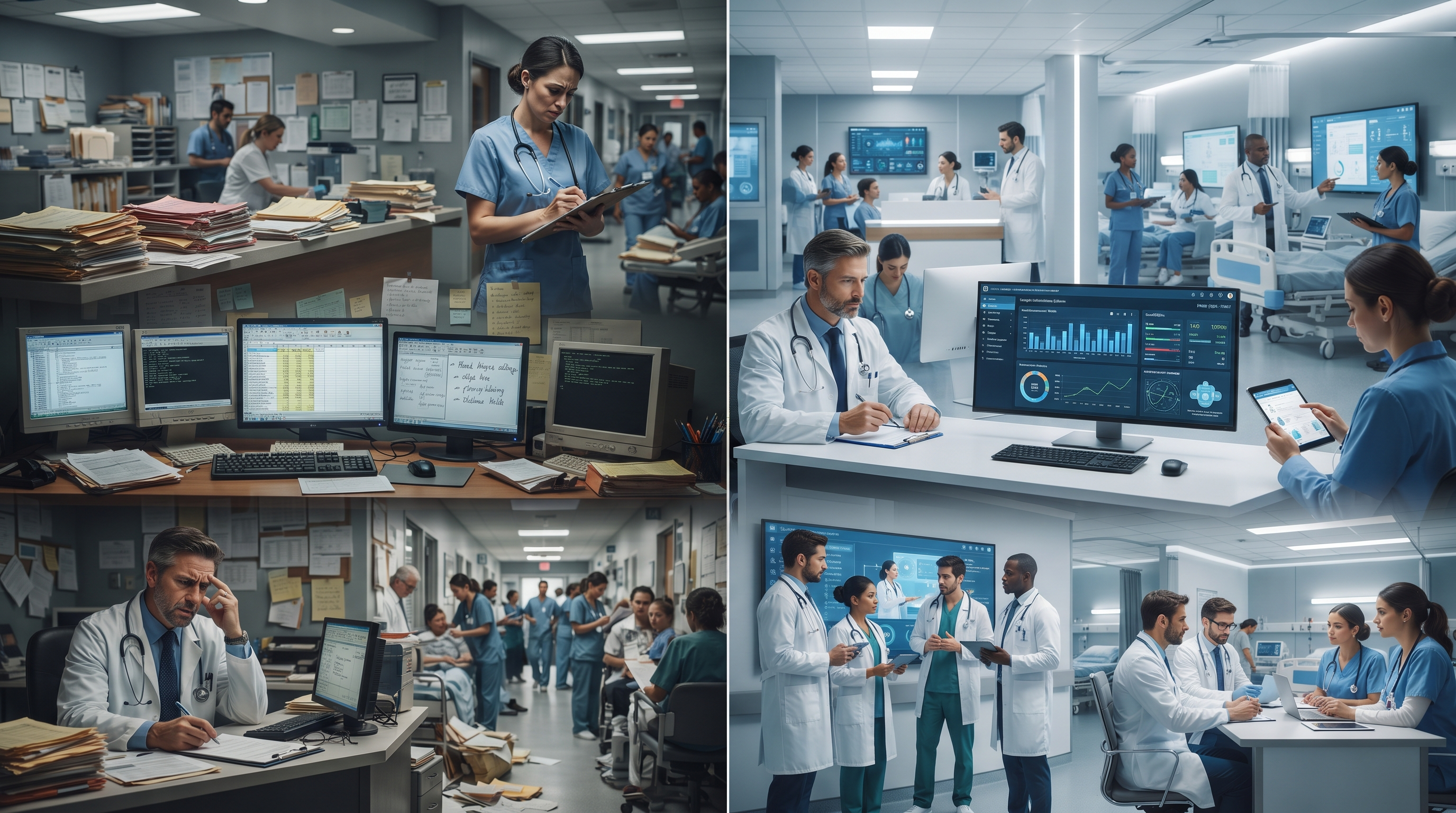
A hospital can replace paper forms with digital forms, purchase several software solutions, and create sophisticated dashboards while continuing to face the same operational problems.
Employees may still enter the same information multiple times. Departments may still work with isolated systems. Managers may still wait for reports before making decisions. Data may exist everywhere but remain difficult to connect and understand.
This is where the difference between real digital transformation and superficial digitalization becomes clear.
What Is Real Digital Transformation in a Hospital?
Real digital transformation is not about the number of systems a hospital owns.
It is about how effectively technology changes the way the hospital operates.
A truly digitally transformed hospital uses technology to:
- Connect departments and information.
- Reduce unnecessary manual processes.
- Eliminate repetitive data entry.
- Improve access to accurate information.
- Automate routine workflows.
- Monitor performance continuously.
- Support faster and more informed decisions.
- Improve resource utilization.
- Create a more consistent patient experience.
In this environment, technology becomes part of the hospital's operating model rather than an additional layer placed on top of existing processes.
A Hospital Information System (HIS) can play an important role in this transformation by connecting different operational and clinical processes and making relevant information available to the people who need it.
The goal is not simply to "go digital."
The goal is to operate better because the hospital is digital.
What Is Fake or Superficial Digital Transformation?
Fake or superficial digital transformation does not necessarily mean that a hospital is using bad technology.
The problem is often how technology is implemented and used.
A hospital may invest heavily in digital solutions but fail to change the underlying processes.
For example, imagine a hospital that previously used paper forms for patient registration.
It introduces a digital registration system.
The process becomes electronic, but employees still have to manually copy the same patient information into several other systems.
The paper is gone.
But the inefficiency remains.
This is digitalization without transformation.
The hospital has changed the format of the process, but not the process itself.
1. More Systems Do Not Always Mean More Digital Transformation
One of the most common misconceptions is that digital maturity can be measured by the number of software systems a hospital uses.
In reality, having more systems can sometimes create more complexity.
A hospital may have separate solutions for:
- Patient registration
- Laboratory
- Radiology
- Pharmacy
- Billing
- Insurance
- Human resources
- Finance
- Inventory
- Medical records
If these systems do not communicate effectively, employees may have to move information manually between them.
The result is a strange situation:
The hospital becomes more digital, but not necessarily more efficient.
Real transformation requires integration and interoperability so that information can move through the organization without unnecessary duplication.
2. Digital Transformation Should Reduce Work, Not Add More Work
Technology should make processes simpler.
However, poorly designed digital transformation can sometimes create additional administrative work.
Consider a nurse who needs to enter the same information into three different systems.
The hospital may technically be operating digitally.
But from the employee's perspective, the digital process has simply created three versions of the same task.
A well-designed Hospital Information System (HIS) should help reduce these repetitions by allowing information captured at one stage of the workflow to become available to authorized users at other relevant stages.
The objective is simple:
Enter information once. Use it where it is needed.
3. Real Transformation Connects Data Across Departments
Hospital data rarely belongs to one department.
A patient's journey can involve registration, consultation, laboratory, radiology, pharmacy, billing, insurance, and other services.
When these processes operate independently, important information can become fragmented.
This creates several problems.
Managers may see financial information without the operational context behind it.
Medical teams may have access to clinical information without visibility into other relevant processes.
Administrative teams may spend time collecting information from different sources before preparing reports.
Real digital transformation creates a connected environment where information can move between appropriate departments and systems.
This creates a much stronger foundation for hospital management.
4. Dashboards Alone Do Not Make a Hospital Data-Driven
Another common example of superficial transformation is the dashboard.
A hospital may have beautiful dashboards displaying dozens of KPIs.
But the real question is:
What decisions are being made because of those dashboards?
A dashboard that only displays numbers is not necessarily creating value.
The real value comes when hospital leaders can use those numbers to identify trends, detect problems, compare performance, and take action.
For example, a dashboard might reveal that waiting times are increasing in a specific department.
That information becomes valuable when management can investigate the underlying causes and take corrective action.
The transformation happens between data and decision.
Not between data and screen.
5. Real Digital Transformation Changes Decision-Making
Traditional hospital management often depends heavily on manual reports, individual experience, and information collected after problems have already occurred.
Digital transformation can change this model.
With integrated systems and reliable data, managers can monitor performance continuously and identify changes earlier.
Instead of asking:
"What happened last month?"
Management can move toward questions such as:
"What is happening now?"
"Why is it happening?"
"Which department is affected?"
"What resources are involved?"
"What action should we take?"
This is one of the most important differences between having technology and actually becoming a data-driven organization.
6. Technology Should Support Business and Clinical Objectives
Digital transformation should never exist as an isolated IT project.
The technology must support the hospital's broader objectives.
For example, if the hospital wants to reduce operating costs, digital initiatives should help identify inefficiencies and unnecessary resource consumption.
If the goal is to improve patient experience, technology should help simplify journeys, reduce unnecessary waiting, and improve access to information.
If the goal is to improve financial performance, systems should help management monitor revenue, billing, claims, costs, and potential leakage.
Technology becomes meaningful when it is connected to measurable organizational objectives.
7. Employee Adoption Is Part of Digital Transformation
Even the most advanced system cannot transform a hospital if employees do not use it effectively.
Digital transformation requires more than software installation.
It requires:
- Proper training
- Clear workflows
- User-friendly interfaces
- Defined responsibilities
- Change management
- Continuous support
- Monitoring and improvement
If employees continue using spreadsheets, personal notes, WhatsApp messages, or manual workarounds because the official system is difficult to use, the transformation remains incomplete.
A successful digital environment should make the correct process easier to follow.
8. Real Transformation Creates One Reliable Source of Information
One of the biggest problems in hospitals is having different versions of the same information.
One department may have one number.
Another department may have a different number.
A spreadsheet may contain an updated version.
A report may contain another version.
Management then spends time trying to determine:
Which number is actually correct?
An integrated Hospital Information System (HIS) can help create a more consistent source of operational and clinical information, subject to proper data governance, system configuration, and access controls.
This allows management to spend less time collecting and reconciling information and more time analyzing it.
9. Real Digital Transformation Is Measurable
A hospital should be able to measure whether its digital transformation is actually producing results.
Useful indicators may include:
- Reduced waiting times
- Fewer duplicate data-entry tasks
- Faster access to information
- Reduced manual reporting
- Improved resource utilization
- Faster billing cycles
- Better claim processing
- Improved workflow visibility
- Higher operational efficiency
- Better patient experience
- Faster management reporting
The exact KPIs will vary from one hospital to another.
But the principle remains the same:
If digital transformation cannot be connected to measurable operational improvements, the hospital should question whether transformation has really occurred.
Real vs. Fake Digital Transformation: The Core Difference
The difference can be summarized simply.
Superficial digitalization asks:
"How can we turn this process into a digital process?"
Real digital transformation asks:
"How can technology fundamentally improve the way this process works?"
The first approach focuses on technology.
The second focuses on outcomes.
The first may create more systems.
The second creates better-connected operations.
The first digitizes existing problems.
The second uses technology to solve them.
How a Hospital Information System (HIS) Supports Real Transformation
A Hospital Information System (HIS) can become an important foundation for genuine digital transformation when it is implemented as part of a broader operational strategy.
Instead of treating the system as software for storing information, hospitals can use it to connect workflows across different functions.
For example, information captured during registration can support subsequent processes without unnecessary re-entry.
Laboratory and radiology information can become available within the appropriate patient workflow.
Financial and operational data can support management reporting.
Dashboards can provide visibility into performance.
And integrated information can help decision-makers understand what is happening across the organization.
This is where the real value of digital transformation begins.
The Hospital of the Future Is Not the One With the Most Technology
The future of healthcare will not necessarily belong to hospitals that purchase the largest number of digital solutions.
It will belong to organizations that know how to make technology work together.
A hospital does not become digitally mature because it has software everywhere.
It becomes digitally mature when information flows efficiently, processes become simpler, decisions become more informed, and technology produces measurable operational value.
That is the real difference between digitalization and digital transformation.
Conclusion
The difference between real and fake digital transformation in hospitals is not the presence or absence of technology.
It is the impact that technology creates.
A hospital can have digital systems and still operate through fragmented data, repetitive tasks, manual reporting, and disconnected departments.
Real transformation goes further.
It connects systems, people, workflows, and information.
It reduces unnecessary work.
It improves visibility.
It supports data-driven decision-making.
And most importantly, it creates measurable improvements in how the hospital operates.
Digital transformation should not be measured by what a hospital has installed.
It should be measured by what the hospital has improved.