Why Being a Smart Hospital Does Not Always Guarantee Success
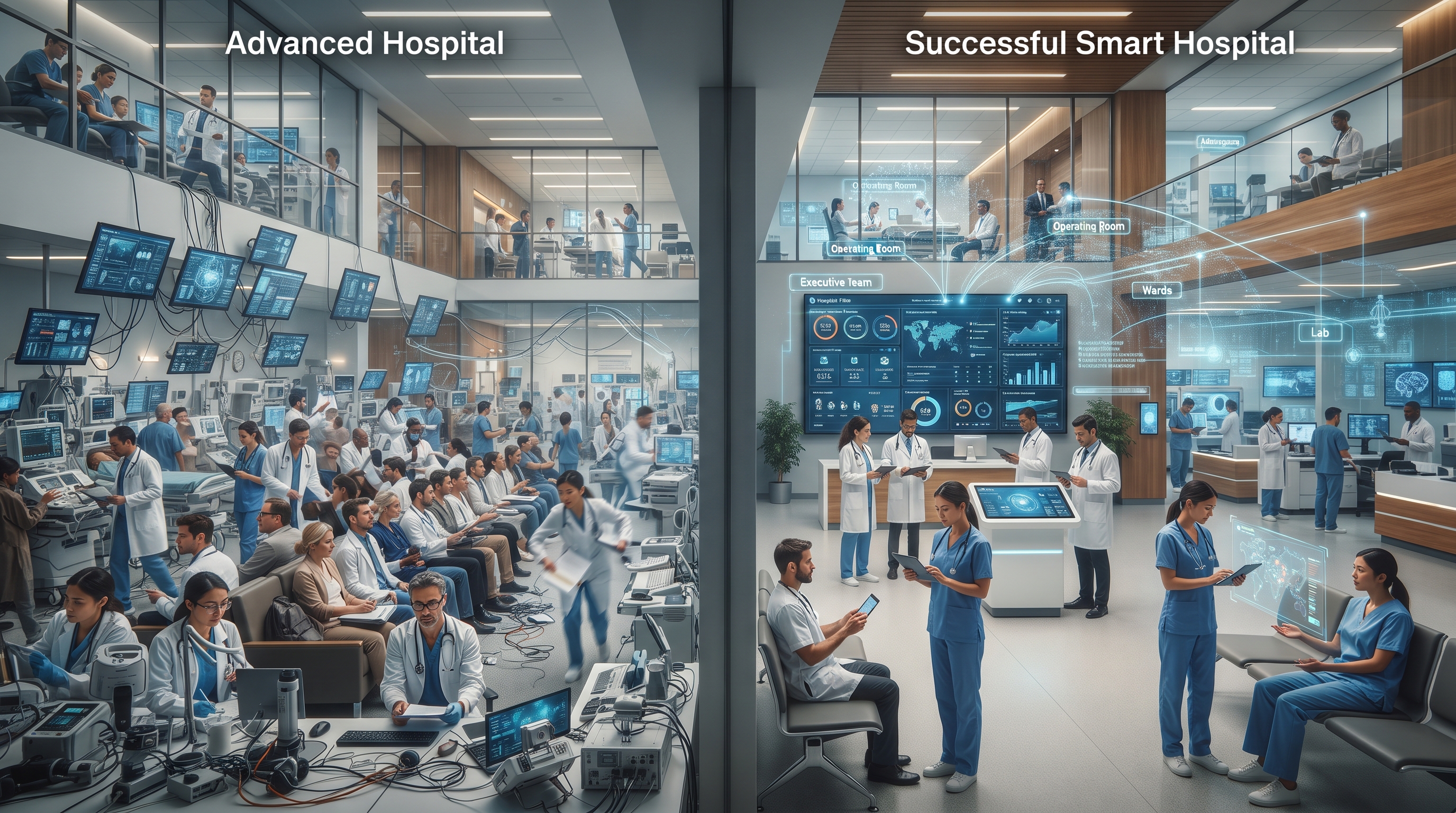
Having advanced technology does not automatically make a hospital successful. A healthcare organization may have a sophisticated Hospital Information System (HIS), artificial intelligence, connected medical devices, and advanced analytics, yet still struggle with high operating costs, long waiting times, inefficient workflows, and poor patient experiences. The real value of a smart hospital comes from how effectively it connects technology, people, processes, and data. This article explores why some technologically advanced hospitals fail to achieve the expected results and what separates a truly successful smart hospital from one that is simply digital.
Over the past decade, the concept of the smart hospital has become one of the most important trends in healthcare.
Hospitals are investing heavily in Hospital Information Systems (HIS), electronic medical records, artificial intelligence, advanced analytics, connected medical devices, automation, appointment management systems, and digital patient services.
On paper, the future looks impressive.
But there is a more important question:
Does having all this technology automatically make a hospital successful?
The answer is no.
A hospital may have sophisticated technology and still experience:
- High operational costs
- Long patient waiting times
- Poor resource utilization
- Low patient satisfaction
- Slow decision-making
- Low employee productivity
- Repetitive processes
- Poor data quality
- Disconnected departments
This reveals a fundamental truth:
A smart hospital is not the hospital with the most technology. It is the hospital that uses technology to consistently achieve better outcomes.
What Is the Difference Between a Smart Hospital and a Successful Hospital?
A smart hospital uses technology, data, automation, and connectivity to improve healthcare operations.
A successful hospital, however, is measured by the results it achieves.
These results may include:
- Better quality of care
- Improved patient experience
- Lower operational waste
- Higher efficiency
- Stronger financial performance
- Better employee productivity
- Faster and more accurate decision-making
- Long-term sustainability
Technology can be the means to achieve these outcomes, but it is not the outcome itself.
A hospital can implement an advanced digital platform without achieving meaningful improvements in performance.
In other words:
More technology does not automatically equal more success.
Problem 1: Technology Without a Clear Strategy
One of the biggest reasons healthcare digital transformation projects fail is that organizations start with technology before defining the problem.
A hospital may decide to purchase a new system because competitors are using it or because the technology has become popular across the healthcare industry.
But the first question should be:
What problem are we trying to solve?
Is the hospital struggling with:
- Long waiting times?
- Poor bed management?
- Rising operational costs?
- Delayed laboratory results?
- Insurance claim denials?
- Revenue leakage?
- Poor resource planning?
- Lack of performance visibility?
Once the problem is clearly identified, technology can be selected according to actual business and clinical needs.
Buying technology simply because it is considered "advanced" can result in significant investment without meaningful returns.
Problem 2: Having a Hospital Information System Without Using It Effectively
A hospital may have a powerful Hospital Information System (HIS) but use only a small percentage of its capabilities.
This is surprisingly common.
Employees may use the system primarily for:
- Patient registration
- Billing
- Appointment management
- Basic documentation
while management fails to take advantage of:
- Advanced analytics
- Executive dashboards
- Performance indicators
- Resource analysis
- Predictive insights
- Operational reporting
- Financial analytics
In this situation, the HIS becomes primarily a data-entry tool rather than a strategic decision-making platform.
This means the hospital is collecting valuable information without fully converting it into value.
The real power of a Hospital Information System lies in its ability to transform:
Data → Information → Insight → Decision → Action
Problem 3: Too Much Data but Too Little Value
Having massive amounts of healthcare data does not automatically make an organization data-driven.
Hospitals generate enormous volumes of information every day.
But if that data is:
- Incomplete
- Inaccurate
- Duplicated
- Fragmented
- Outdated
- Difficult to analyze
then its strategic value becomes limited.
This is why hospitals need to move beyond simple data collection.
The real progression should be:
Data Collection → Data Quality → Data Analysis → Actionable Insights
The objective is not to collect the largest amount of information.
The objective is to make the information useful.
Problem 4: Disconnected Healthcare Systems
A hospital may have separate systems for:
- Laboratory
- Radiology
- Pharmacy
- Billing
- Insurance
- Human resources
- Hospital management
But what happens when these systems cannot communicate effectively?
Employees may need to enter the same information multiple times.
Physicians may have to search through different systems to find patient information.
Management may struggle to obtain a unified view of hospital performance.
In this situation, technology can actually increase complexity.
This is why healthcare system integration is a fundamental component of a truly smart hospital.
A smart hospital should not be a collection of disconnected digital systems.
It should operate as an integrated digital ecosystem.
Problem 5: Ignoring Employees
A hospital can invest in the most advanced healthcare technology available, but if employees do not adopt it properly, the expected benefits may never materialize.
This is known as user adoption.
Employees may resist a new system because of:
- Poor usability
- Too many steps
- Insufficient training
- Lack of understanding
- Fear of change
- Poor alignment with existing workflows
This is why digital transformation is not simply an IT project.
It is an organizational change project.
Employees need to understand not only how to use the technology, but also why it matters and how it makes their work easier and more effective.
Problem 6: Choosing a System That Does Not Fit the Workflow
Another common mistake is forcing employees to adapt their entire workflow to a system that was not designed around their actual operational needs.
Every hospital is different.
Hospitals have different:
- Sizes
- Specialties
- Staffing structures
- Patient volumes
- Processes
- Operational requirements
Therefore, a Hospital Information System (HIS) needs to be flexible and adaptable.
The best system is not necessarily the one with the largest number of features.
It is the one that enables healthcare professionals to complete their work faster, more accurately, and with fewer unnecessary steps.
Problem 7: Focusing on Equipment Instead of Processes
Hospitals can invest millions in advanced medical equipment while leaving outdated administrative and operational processes untouched.
This creates a major contradiction:
Advanced technology + outdated processes = limited performance
A modern medical device may generate highly sophisticated information, but if that information cannot reach the physician or central system efficiently, the hospital may not receive the full value of the investment.
Technology must therefore operate as part of a larger ecosystem:
Medical Devices + Systems + Data + People + Processes + Management
Problem 8: Lack of Performance Indicators
How can hospital management determine whether digital transformation has actually worked?
Without measurable KPIs, it becomes difficult to answer that question objectively.
Hospitals should monitor indicators such as:
- Average patient waiting time
- Average length of stay
- Bed occupancy rate
- Appointment cancellation rate
- Laboratory turnaround time
- Radiology reporting time
- Cost per service
- Insurance claim denial rate
- Employee productivity
- Patient satisfaction
- Department revenue
These indicators help management move beyond assumptions and evaluate whether technology is producing measurable improvements.
Problem 9: Ignoring the Patient Experience
A hospital may be technologically advanced behind the scenes while still delivering a poor patient experience.
This is a serious problem.
Patients do not necessarily care how many systems are operating behind the scenes.
They care about what they experience.
Can they book an appointment easily?
Do they have to wait for hours?
Can they find the right department?
Do they need to provide the same information repeatedly?
Are their results available when expected?
Does information move smoothly between departments?
If technology does not improve the patient's journey, it is difficult to describe the digital transformation as fully successful.
Problem 10: Lack of Executive Visibility
One of the most valuable capabilities of a Hospital Information System (HIS) is providing management with a clear view of organizational performance.
But if reports are:
- Delayed
- Fragmented
- Inaccurate
- Difficult to understand
management may continue operating reactively.
Modern executive dashboards can provide visibility into:
- Financial performance
- Operational performance
- Department KPIs
- Patient volumes
- Resource utilization
- Quality indicators
This allows leadership to move from:
"What happened?"
to:
"Why did it happen, and what should we do next?"
That shift represents a major difference between traditional management and data-driven hospital management.
Artificial Intelligence Is Not a Magic Solution
Artificial intelligence is becoming an increasingly important part of the healthcare industry.
However, simply adding AI to a hospital does not automatically make it smart.
If the underlying data is incomplete, inaccurate, or fragmented, advanced analytics may produce unreliable insights.
AI requires:
- High-quality data
- Integrated systems
- Appropriate infrastructure
- Trained employees
- Clear objectives
- Strong data governance
Therefore, artificial intelligence should be considered part of a broader digital strategy rather than an isolated technology.
How Can Hospitals Know If Their Digital Transformation Is Working?
Hospital leadership can evaluate digital transformation by asking several practical questions.
Has patient waiting time decreased?
If waiting times remain unchanged despite significant technology investments, something may be wrong with the underlying workflow.
Are decisions becoming faster?
If management still depends on manually prepared reports, the organization may not be using its data effectively.
Have operational costs decreased?
Digital transformation should contribute to reducing waste and improving resource utilization.
Has employee experience improved?
If employees find the new system more complicated than the previous process, usability or training issues may exist.
Has patient experience improved?
The impact of technology should be visible in the patient's journey, not only in the hospital's IT infrastructure.
Has data become actionable?
The ultimate goal is not simply to see numbers.
It is to use those numbers to make better decisions.
From a Digital Hospital to a Smart Hospital
There is an important distinction between a digital hospital and a smart hospital.
A digital hospital may simply replace paper-based processes with electronic systems.
A smart hospital goes further.
It uses digital systems to understand what is happening, identify patterns, predict potential problems, and improve future decisions.
The transformation can be viewed as:
Paper-Based Hospital
↓
Digital Hospital
↓
Connected Hospital
↓
Data-Driven Hospital
↓
Smart Hospital
This demonstrates that digital transformation is not a single implementation project.
It is a continuous journey.
How Can Hospitals Get More Value From Technology?
To achieve meaningful results, hospitals should begin with their operational needs rather than technology trends.
1. Identify the Problems
Start with the processes creating the greatest inefficiencies, delays, or costs.
2. Define Success Metrics
Establish measurable KPIs before implementing new technology.
3. Select the Right Technology
Choose systems based on actual clinical and operational requirements rather than feature count alone.
4. Integrate Systems
Connect departments and applications so information can move smoothly throughout the patient's journey.
5. Train Employees
Technology cannot create value without the people who use it.
6. Improve Data Quality
Accurate decisions require accurate information.
7. Continuously Measure Results
A digital project should not be considered successful simply because the system has gone live.
Hospitals should compare performance before and after implementation.
The Real Meaning of a Smart Hospital
The real smart hospital is not necessarily the hospital with the most screens, the most AI tools, or the most expensive medical equipment.
It is the hospital where technology works quietly in the background to make healthcare operations better.
A truly smart hospital should allow:
Doctors to access information faster.
Nurses to manage workflows more efficiently.
Managers to understand performance in real time.
Finance teams to identify revenue leakage.
Administrators to allocate resources more effectively.
Patients to experience a smoother healthcare journey.
When technology achieves these outcomes, it stops being an investment in IT and becomes an investment in organizational performance.
Conclusion
A smart hospital does not automatically mean a successful hospital.
Technology alone cannot create success.
A hospital may have an advanced Hospital Information System (HIS), artificial intelligence, modern medical equipment, sophisticated analytics, and multiple digital platforms, yet continue to struggle with operational, financial, and administrative problems.
The real challenge is connecting technology with strategy, people, processes, and data.
Digital transformation becomes valuable when data helps management make better decisions, systems help employees work more efficiently, integration enables physicians to access information faster, automation reduces waste, and patients experience meaningful improvements in their healthcare journey.
Ultimately, hospital leaders should not ask:
"Are we a smart hospital?"
They should ask:
"Is technology making us more efficient, more accurate, more sustainable, and better able to deliver high-quality healthcare?"
If the answer is yes, technology has become a genuine driver of hospital success.
If the answer is no, the hospital may simply be technologically advanced without being operationally intelligent.