Why Hospital Executives Need Real-Time Dashboards for Smarter Decision-Making
Hospitals generate large volumes of operational, financial, administrative, and clinical data every day. However, having access to large amounts of data does not automatically mean that hospital executives have the information they need to make timely decisions.
Traditional reports often show what happened hours, days, or even weeks ago. Real-time hospital dashboards, on the other hand, can provide executives with a continuously updated view of critical performance indicators.
By connecting data from a Hospital Information System (HIS) and other integrated systems, real-time dashboards can help hospital leadership monitor what is happening now, identify unusual changes, and respond to operational and financial challenges more effectively.
Why Hospital Executives Need Real-Time Dashboards
Hospital executives are responsible for overseeing much more than individual departments. They need to understand financial performance, patient flow, resource utilization, operational efficiency, service demand, staffing, emergency department pressure, and many other factors.
The challenge is not simply having enough data.
The real challenge is turning large amounts of data into clear, timely information that supports better decisions.
A hospital may have dozens of reports, spreadsheets, and specialized systems. But if an executive has to manually collect information from multiple sources before understanding the current situation, the information may already be outdated by the time it becomes available.
This is where real-time dashboards become valuable.
What Is a Real-Time Dashboard in a Hospital?
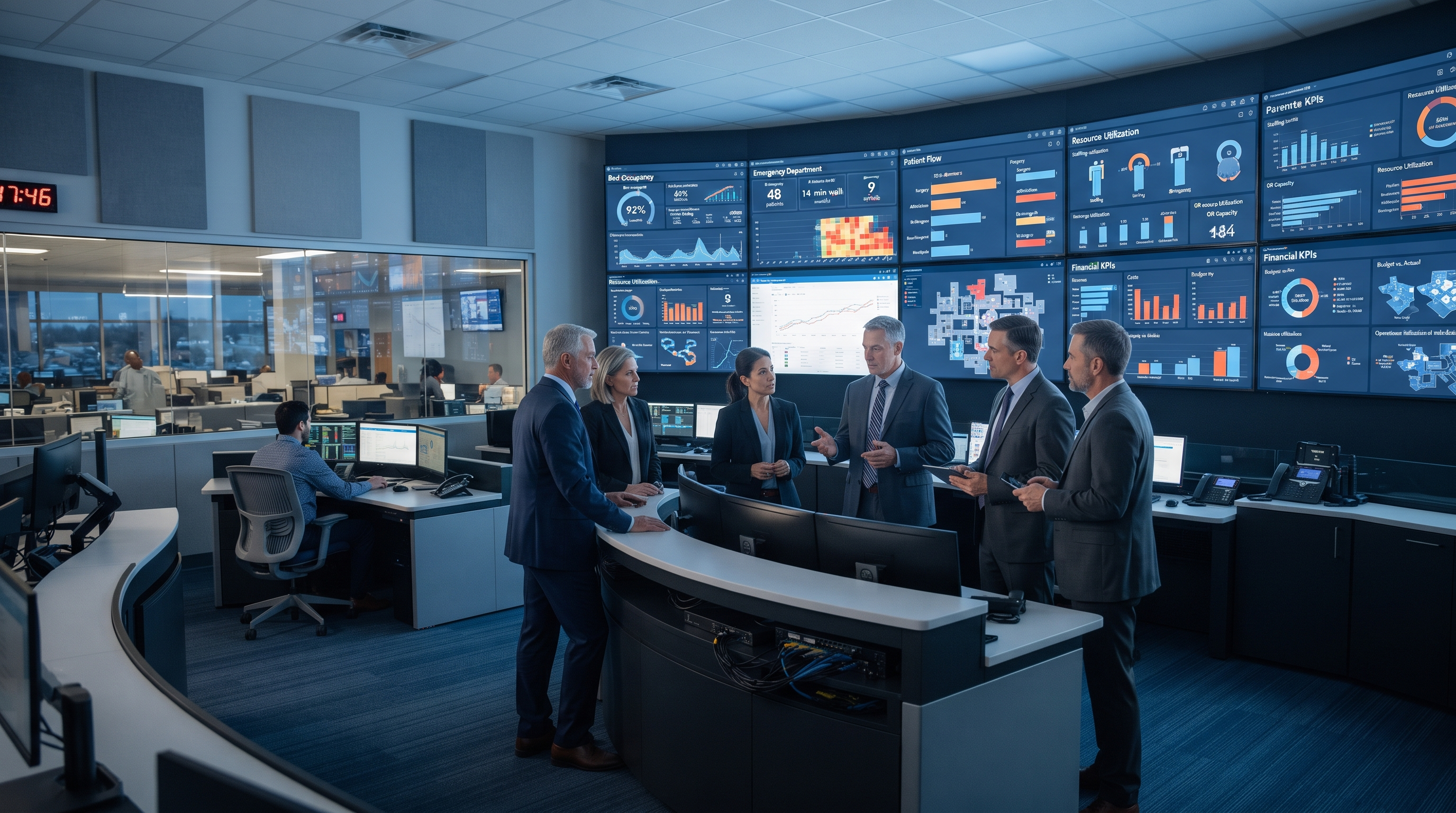
A real-time hospital dashboard is a digital interface that brings together important data and key performance indicators into a clear, centralized view.
Instead of reviewing multiple reports separately, hospital executives can monitor selected operational, financial, and administrative indicators from a single dashboard.
Depending on the hospital's systems and integration capabilities, a dashboard may display:
- Patient volumes and visits.
- Bed occupancy rates.
- Department performance.
- Waiting times.
- Procedures and services.
- Revenue and expenses.
- Resource utilization.
- Insurance claims.
- Emergency department activity.
- Key Performance Indicators (KPIs).
The objective is not simply to display more numbers.
The objective is to create a clearer operational picture of the hospital.
The Problem Is Not the Reports — It Is Their Timing
Traditional hospital reports remain important for historical analysis, financial reviews, performance evaluations, and strategic planning.
However, relying exclusively on periodic reports can become a problem when executives need to respond to situations that are changing quickly.
Imagine that hospital management reviews a weekly report and discovers that the average waiting time in a department has increased significantly.
The next questions immediately become:
When did the increase begin?
Is it still happening?
Which service or department is contributing to it?
Is the increase related to higher patient volume, limited resources, or a bottleneck in the workflow?
The longer it takes to answer these questions, the harder it may become to respond at the right time.
A real-time dashboard can make important changes more visible and help executives monitor performance while operations are taking place.
Real-Time Dashboards Give Executives a Single View
One of the biggest challenges in hospital management is the fragmentation of information.
Financial data may exist in one system, registration data in another, laboratory information somewhere else, and operational data across several departments.
When these sources are disconnected, executives may struggle to develop a consistent view of hospital performance.
When data is properly integrated, including data generated through a Hospital Information System (HIS), important indicators can be brought together into a more centralized management view.
This does not necessarily mean replacing every specialized system with one platform.
Instead, it means enabling different systems and departments to communicate effectively so that management can make better use of the information they generate.
How Do Real-Time Dashboards Support Faster Decisions?
Effective management decisions depend on having the right information at the right time.
When executives can see that a particular indicator is changing significantly, they can investigate the situation earlier.
For example, if emergency department pressure begins to increase, management may monitor related indicators such as:
- Patient volume.
- Admission and discharge rates.
- Waiting times.
- Bed availability.
- Service demand.
- Resource utilization.
Instead of waiting for an end-of-day or end-of-week report, executives can monitor these indicators as the situation develops.
The dashboard does not make the decision for management.
It provides the information needed to make the decision.
Hospital Dashboards Are Not Only About Clinical Data
A common misconception is that hospital dashboards are primarily designed to display clinical information.
For hospital executives, the bigger picture includes clinical, operational, financial, and administrative performance.
Operational Performance
Dashboards can monitor patient volumes, waiting times, bed utilization, department activity, procedures, and other operational indicators.
Financial Performance
Executives can monitor revenue, expenses, service performance, outstanding amounts, and other financial indicators relevant to the hospital's financial position.
Resource Utilization
Management can monitor how available resources are being used in relation to demand and operational requirements.
Insurance Performance
Relevant dashboards can help monitor claims volumes, rejection rates, delays, and other indicators that may affect financial processes.
This makes the dashboard a management tool rather than simply a collection of medical charts.
Moving From "What Happened?" to "What Is Happening Now?"
One of the most important advantages of real-time dashboards is the shift in the way organizations interact with data.
Traditional reporting often answers:
What happened?
A continuously updated dashboard helps answer:
What is happening now?
Advanced analytics can potentially add another question:
What direction are we moving in?
This progression makes data more useful for management because it can support not only historical reporting but also current monitoring and forward-looking analysis.
Identifying Problems Before They Become Operational Crises
Continuous monitoring can help executives notice unusual changes earlier.
For example, a hospital may experience:
- Increasing waiting times.
- Growing pressure on a specific resource.
- Unexpected changes in service demand.
- Increasing emergency department activity.
- A decline in an important financial indicator.
A single change does not necessarily mean that a crisis exists.
However, when multiple indicators move in the same direction, the combination may provide an early signal that deserves investigation.
In this context, a real-time dashboard can become part of an early-warning approach to hospital management, provided that the underlying data is reliable and the selected indicators are meaningful.
Why Does Information Speed Matter to Hospital Executives?
The faster an operational environment changes, the more important information timing becomes.
Hospital activity can change continuously as patient volumes, resource availability, service demand, and operational conditions change.
Therefore, the difference between receiving information at the appropriate time and receiving it after the situation has already changed can be significant.
The goal is not simply to collect more data.
The goal is to reduce the time between a change occurring, understanding it, and responding to it.
How Does a Hospital Information System (HIS) Support Real-Time Dashboards?
A Hospital Information System (HIS) can serve as an important source of operational and administrative data, depending on its capabilities and its integration with other hospital systems.
When this data is transformed into meaningful dashboards, executives can move from reviewing isolated records and reports to monitoring consolidated performance indicators.
However, having a Hospital Information System (HIS) alone is not enough.
If the underlying data is incomplete, inaccurate, outdated, or poorly integrated, the dashboard will not provide a reliable management picture.
This is why effective hospital analytics depends on a broader data process:
Data Collection → Integration → Organization → Analysis → Visualization → Decision-Making
The dashboard is the visualization and monitoring layer within this larger process.
What Makes a Hospital Dashboard Truly Useful?
A dashboard is not automatically valuable simply because it contains charts and graphs.
Several factors determine whether it can actually support hospital management.
1. Relevant KPIs
Executives do not need dozens of indicators that have little connection to their objectives.
The dashboard should focus on the Key Performance Indicators that are relevant to the decisions being made.
2. Reliable Data
Decisions based on inaccurate information can lead to inaccurate conclusions.
Data quality, consistency, and appropriate update cycles are therefore essential.
3. Clear Visualization
Executives should be able to understand the overall situation quickly and access additional details when needed.
4. Meaningful Comparisons
A current number often means little without context.
Dashboards can become more useful when indicators are compared with previous periods, targets, benchmarks, or expected levels.
5. Drill-Down Capabilities
If an indicator changes unexpectedly, executives should ideally be able to move from the high-level metric to more detailed information that helps identify the source of the change.
Should Every Hospital Department Use the Same Dashboard?
Not necessarily.
A Chief Executive Officer may need strategic, financial, and operational indicators.
A Chief Financial Officer may require more detailed financial and revenue-related information.
An operations manager may need information about patient flow, capacity, resources, and department performance.
A department manager may require even more granular operational data.
Therefore, effective hospital dashboards should be designed around the user's role, responsibilities, permissions, and decision-making requirements.
One dashboard containing every available hospital metric can easily become overwhelming.
The goal is not maximum information.
The goal is maximum relevance.
From Hospital Data to a Data-Driven Management Culture
The value of real-time dashboards extends beyond displaying numbers.
When relevant information becomes consistently available, the way management discussions take place can also change.
Instead of relying primarily on assumptions or subjective impressions, management meetings can begin with measurable indicators.
Instead of asking:
"Is this department performing well?"
Management can ask:
"Why did this indicator change, and what happened during this period?"
This creates a stronger foundation for data-driven management, continuous improvement, and evidence-based operational planning.
Real-Time Dashboards and the Future of Hospital Management
As hospitals continue their digital transformation, the importance of connected data is likely to increase.
Executives will increasingly need visibility across multiple areas of the organization rather than isolated reports from individual departments.
Real-time dashboards can provide an important management layer by bringing these indicators together and making them easier to monitor.
When combined with reliable data integration, analytics, and appropriate hospital management systems, dashboards can help leadership move from reactive management toward more proactive monitoring.
However, technology alone does not create better management.
The value comes from combining accurate data, meaningful KPIs, effective visualization, and informed human decisions.
Conclusion
Hospital executives need real-time dashboards because modern hospital management requires more than knowing what happened in the past.
Leadership needs to understand what is happening now, recognize important changes, monitor performance, and have the information required to respond appropriately.
A well-designed real-time hospital dashboard can bring together operational, financial, administrative, and other relevant indicators into a clearer management view.
When supported by a Hospital Information System (HIS) and properly integrated data sources, dashboards can help reduce the gap between data generation and executive decision-making.
But the true value of a dashboard does not come from the number of charts it contains.
It comes from its ability to present the right information, to the right decision-maker, at the right time.
Ultimately, a digitally mature hospital is not simply one that generates large amounts of data. It is one that can transform that data into meaningful information and use it to make timely, informed decisions.