Why Integrating LIS and RIS with Hospital Information Systems (HIS) Is Essential for Healthcare Efficiency
As hospitals continue to embrace digital transformation, the integration of medical systems has become essential for improving operational efficiency and delivering high-quality patient care. One of the most critical integrations in modern healthcare environments is the connection between Laboratory Information Systems (LIS), Radiology Information Systems (RIS), and Hospital Information Systems (HIS). By integrating these systems, hospitals can streamline workflows, reduce manual errors, and ensure that doctors have instant access to accurate diagnostic data. In this article, we explore why integrating laboratory and radiology systems with HIS is crucial for modern hospitals.
Healthcare institutions around the world are undergoing rapid digital transformation. Hospitals are increasingly relying on advanced information systems to manage clinical operations, patient data, and administrative processes more efficiently. At the center of this digital infrastructure is the Hospital Information System (HIS), which serves as the core platform for managing healthcare information across departments.
However, to fully unlock the potential of HIS, hospitals must integrate it with other specialized systems such as Laboratory Information Systems (LIS) and Radiology Information Systems (RIS). These systems generate critical diagnostic data that physicians rely on for accurate decision-making.
Without proper integration, hospitals may experience data silos, delays in diagnosis, and inefficient workflows. Integrating laboratory and radiology systems with HIS ensures seamless data flow across departments, enabling healthcare professionals to access the right information at the right time.
In this article, we will explore the importance of integrating LIS and RIS with HIS, the benefits for hospitals, and how this integration improves both clinical outcomes and operational efficiency.
Understanding Hospital Information Systems (HIS)
A Hospital Information System (HIS) is a comprehensive digital platform used to manage clinical, financial, and administrative processes within a hospital.
The system typically includes modules for:
- Patient registration and scheduling
- Electronic Medical Records (EMR)
- Billing and insurance management
- Pharmacy management
- Staff management
- Reporting and analytics
HIS acts as the central hub where all hospital data is stored and managed. When integrated with other healthcare systems, it creates a unified ecosystem that improves information accessibility and coordination between departments.
What Are LIS and RIS?
Laboratory Information System (LIS)
A Laboratory Information System (LIS) is a specialized software designed to manage laboratory operations and data.
It helps laboratories perform tasks such as:
- Managing test orders
- Tracking patient samples
- Recording laboratory results
- Automating laboratory workflows
- Delivering results to physicians
LIS improves laboratory efficiency while ensuring the accuracy and reliability of test results.
Radiology Information System (RIS)
A Radiology Information System (RIS) is used to manage imaging workflows within radiology departments.
RIS typically supports:
- Radiology scheduling
- Patient imaging records
- Radiology reporting
- Integration with imaging systems like PACS
- Radiologist workflow management
RIS plays a vital role in managing diagnostic imaging processes and improving communication between radiologists and physicians.
Why Integration Between HIS, LIS, and RIS Is Important
Faster Access to Diagnostic Data
One of the most significant advantages of integrating LIS and RIS with HIS is the ability for physicians to access diagnostic data instantly.
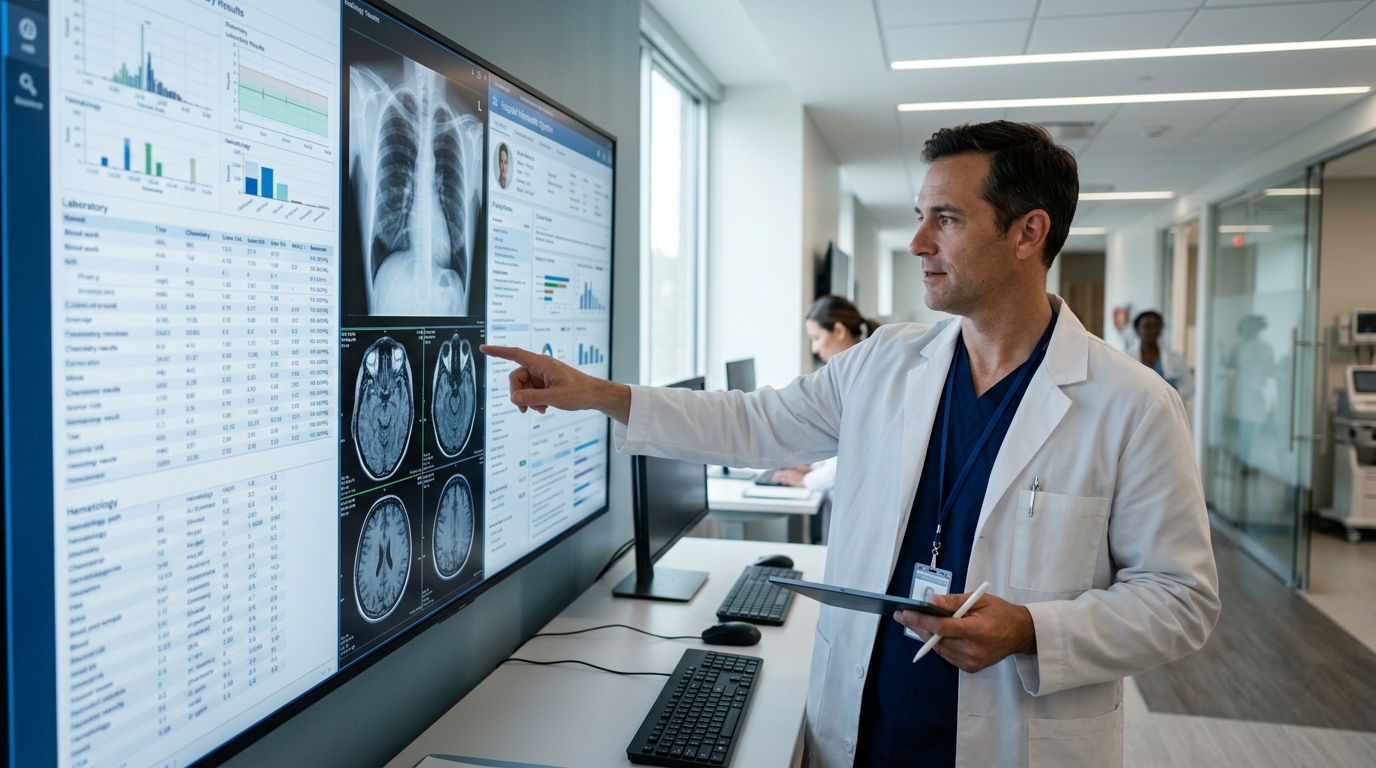
When laboratory results and radiology reports are automatically linked to the patient’s electronic medical record, doctors can review all relevant information without switching between multiple systems.
This leads to:
- Faster diagnoses
- Reduced patient waiting time
- Improved clinical decision-making
Improved Diagnostic Accuracy
Accurate diagnosis depends on having complete and reliable medical data.
Integration allows physicians to view laboratory results, imaging reports, and patient history in one place. This comprehensive view helps doctors make better-informed treatment decisions and reduces the likelihood of diagnostic errors.
Reduction of Manual Errors
In traditional hospital environments where systems operate independently, staff often need to manually transfer data between departments. This process increases the risk of human error.
Integration eliminates these risks by automating data exchange between systems. Laboratory results and imaging reports are automatically uploaded into the patient record within HIS.
This significantly improves data accuracy and reliability.
Enhanced Workflow Efficiency
Hospitals are complex organizations where multiple departments must collaborate efficiently.
When LIS and RIS are integrated with HIS:
- Test orders can be sent electronically to laboratories
- Imaging requests can be scheduled automatically
- Results can be delivered directly to physicians
This streamlined workflow reduces administrative workload and improves overall productivity.
Better Patient Experience
Patients benefit significantly from integrated healthcare systems.
With seamless data exchange between departments:
- Waiting times for test results are reduced
- Diagnoses are delivered faster
- Treatment can begin earlier
These improvements enhance patient satisfaction and build trust in healthcare providers.
Improved Data Analytics and Decision-Making
When laboratory and radiology data are integrated into the central HIS database, hospitals gain access to valuable healthcare analytics.
Administrators can analyze data to:
- Identify disease trends
- Monitor diagnostic accuracy
- Improve departmental efficiency
- Optimize resource allocation
Data-driven insights help hospitals make strategic decisions that improve performance and patient care.
Supporting Digital Transformation in Healthcare
Digital transformation is reshaping the healthcare industry. Hospitals are moving toward fully integrated digital ecosystems where all medical data is connected and accessible.
Integrating LIS and RIS with HIS is a critical step toward building a smart hospital infrastructure. This integration allows hospitals to:
- Eliminate data silos
- Improve communication between departments
- Enhance operational transparency
- Support advanced technologies such as AI diagnostics
A connected healthcare system enables hospitals to deliver faster, safer, and more efficient medical services.
Challenges of Healthcare System Integration
Despite its benefits, system integration can present several challenges.
Hospitals may face issues such as:
- Compatibility between different software systems
- Data standardization requirements
- Implementation costs
- Staff training needs
However, these challenges can be addressed through proper planning, selecting interoperable systems, and working with experienced healthcare technology providers.
The Future of Integrated Healthcare Systems
As healthcare technology continues to evolve, system integration will become even more important.
Future healthcare systems will rely on technologies such as:
- Artificial Intelligence in diagnostics
- Predictive analytics for disease prevention
- Advanced clinical decision support systems
- Real-time patient monitoring
These innovations depend on seamless data integration across healthcare platforms.
Hospitals that invest in integrated information systems today will be better prepared for the future of digital healthcare.
Conclusion
Integrating Laboratory Information Systems (LIS) and Radiology Information Systems (RIS) with Hospital Information Systems (HIS) is no longer optional for modern healthcare institutions.
This integration enables hospitals to streamline workflows, improve diagnostic accuracy, reduce manual errors, and enhance the overall patient experience.
By creating a unified digital ecosystem, hospitals can ensure that healthcare professionals have access to complete and reliable medical information at all times.
Ultimately, system integration plays a vital role in supporting digital transformation and helping hospitals deliver safer, faster, and more efficient healthcare services.